



















The holiday rush can be one of the most profitable periods of the year for retailers—but only if the products customers want are available when they are ready to buy.
Retailers often order inventory weeks or months before holiday revenue reaches their bank account. Suppliers may require deposits or full payment in advance, while freight, marketing campaigns, packaging, seasonal labor, and other holiday expenses add to the upfront cost.
Holiday inventory financing helps businesses bridge the cash flow gap between purchasing seasonal inventory and collecting revenue from holiday sales. It can give retailers access to funds for stocking proven products, placing bulk orders, managing shipping delays, and quickly reordering popular items.
However, borrowing also creates repayment obligations. Before accepting an offer, a business should have a clear plan based on realistic sales forecasts, margins, financing costs, and post-holiday cash flow.
What Is Holiday Inventory Financing?
Holiday inventory financing is business funding used to purchase merchandise before a peak shopping period. Although the term refers to the holiday season, the same strategy may apply to any predictable seasonal increase in demand.
A retailer might use the funds to purchase:
- Holiday gifts and seasonal merchandise
- Raw materials or product components
- Packaging and shipping supplies
- Proven best sellers
- Limited-edition products
- Restaurant ingredients and beverages
- Salon, spa, or wellness products
- E-commerce inventory
- Replacement stock during the holiday rush
The objective is to purchase enough of the right inventory without draining the cash required for payroll, rent, marketing, utilities, and daily operations.
How Does Holiday Inventory Financing Work?
The business first estimates its seasonal inventory needs and the total amount required. It then submits a loan application to a lender or financing provider, which may review the company’s revenue, cash flow, bank account activity, time in business, credit history, and intended use of funds.
If approved, the business receives either a lump sum or access to a revolving credit limit, depending on the financing product. The funds can then be used to purchase inventory and cover related business expenses.
Repayment terms vary depending on the lender, loan amount, credit profile, financing structure, and financial situation of the applicant. Payments may be required daily, weekly, biweekly, or monthly.
Why Do Retailers Finance Holiday Inventory?
A retailer may know that demand is coming but lack the available cash to purchase sufficient stock.
For example, a business might need to pay a supplier in September or October for products it expects to sell in November and December. Even if those products sell successfully, the revenue arrives after the purchase must be made.
Inventory financing bridges this timing gap. It allows the business to purchase goods before peak shopping begins and repay the financing as sales generate cash.
The U.S. Small Business Administration recognizes seasonal inventory and receivables as legitimate working-capital needs. Its Seasonal CAPLine program is specifically designed to finance seasonal increases in inventory, accounts receivable, and, in some cases, related labor costs. (sba.gov)
How Can Inventory Financing Prevent Holiday Stockouts?
High seasonal demand can result in lost sales when a retailer runs out of popular products. Stockouts may also send customers to competing businesses at a time when shoppers prioritize availability and delivery speed.
Timely holiday inventory financing can help a business:
- Place inventory orders before supplier deadlines
- Purchase higher quantities of proven products
- Maintain safety stock for unexpected demand
- Secure packaging and shipping materials
- Replace damaged or delayed inventory
- Reorder popular items while demand remains high
- Avoid using all available operating cash
Financing cannot guarantee that every product will be available. It can, however, give the retailer more purchasing flexibility when its cash is committed elsewhere.
Build a Forecast Before You Borrow
Effective forecasting can help prevent two expensive outcomes: losing sales because of insufficient stock and carrying unsold inventory after the holidays.
Start by reviewing previous seasonal sales, current buying patterns, supplier lead times, customer preorders, website traffic, marketing plans, and broader changes in the business.
Divide the forecast into three categories:
Core inventory
These are proven products that sell throughout the year and are likely to remain useful after the holidays.
Seasonal inventory
These products have strong holiday demand but may become difficult to sell once the season ends.
Experimental inventory
These are new products without enough historical sales data to support a confident forecast.
Financing core and proven seasonal inventory may involve less risk than borrowing heavily for untested merchandise.
Calculate the Full Cost of Holiday Inventory
The purchase price is not the only cost a retailer should include in its holiday budget.
Calculate the total cost of:
- Inventory
- Freight and expedited shipping
- Customs or import charges
- Warehousing
- Packaging
- Credit-card processing
- Marketplace fees
- Marketing campaigns
- Seasonal employees
- Overtime
- Returns and refunds
- Discounts and markdowns
- Financing fees and interest
A product may generate strong sales without producing enough profit to justify borrowing. The relevant question is not simply, “How much revenue could this inventory generate?” It is, “How much profit could remain after every associated cost is paid?”
Use a Conservative Sales Estimate
A financing decision should not depend on the best possible sales outcome.
Create at least three projections:
- Expected case: Sales follow the most likely forecast.
- Strong case: Demand exceeds the forecast.
- Conservative case: Sales fall meaningfully below expectations.
The business should determine whether it can still make each required payment under the conservative case. If repayment depends entirely on selling every item at full price, the financing plan may leave too little room for delays, returns, discounts, or changing demand.
Compare Gross Profit With Financing Cost and Interest Rates
A simple calculation can help determine whether borrowing makes financial sense:
Expected sales revenue
– cost of inventory
– fulfillment and operating expenses
– total financing cost
– risk reserve
= estimated financial benefit
Suppose a retailer borrows to purchase $40,000 of additional inventory. The business projects $75,000 in sales but expects $18,000 in marketing, labor, fulfillment, returns, and financing costs.
That leaves an estimated $17,000 before taxes and other overhead. The owner should then test what happens if sales reach only $60,000 or if some products require post-holiday markdowns.
This example is hypothetical and does not represent guaranteed results.
Holiday Inventory Financing Options
Different loan options suit different business models, purchasing cycles, and repayment needs. Business owners should compare the funding amount, total cost, payment frequency, collateral requirements, fees, and repayment periods—not simply the advertised interest rate.
Business Line of Credit
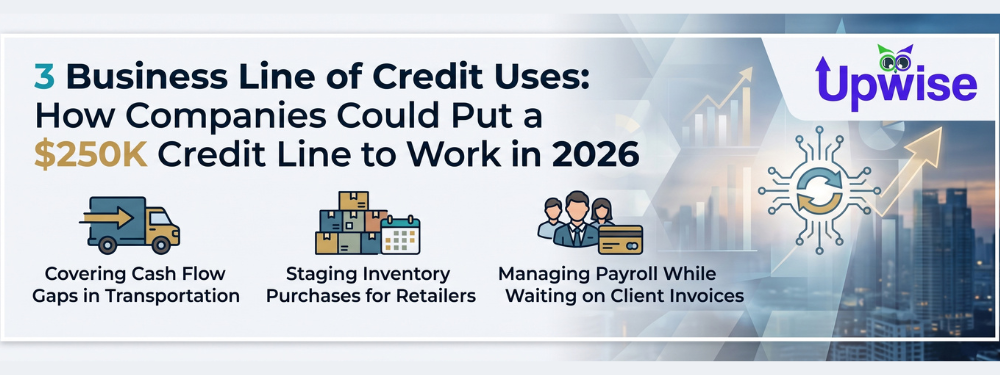
A business line of credit provides access to a maximum credit limit. The business can draw funds when necessary instead of receiving the full loan amount at once.
A line of credit may be useful when a retailer expects to make several orders or needs the flexibility to quickly reorder popular items. Under many structures, interest is charged only on the funds drawn rather than the entire available limit.
Upwise Capital offers business lines of credit with weekly or monthly payment options, subject to application, underwriting, and approval.
Working Capital Financing
Working capital can cover short-term business needs such as inventory, payroll, supplier payments, marketing, packaging, and shipping.
Some working capital products base approval and remittance on the company’s revenue rather than relying exclusively on its credit score. This may provide quick access to funds, but short-term products can cost more than traditional bank financing.
Businesses should carefully review whether payments are fixed or tied to revenue and whether the structure could create repayment pressure during a slower post-holiday period. Upwise identifies inventory and seasonal cash flow as potential uses for working capital funding.
Business Term Loan
A term loan provides a lump sum that is repaid according to an agreed schedule. Depending on the offer, the loan may have fixed interest rates, variable rates, or another pricing structure.
A term loan may be appropriate when the business knows exactly how much money it needs and wants a structured repayment schedule. However, borrowing the entire amount at once may be less flexible than using a revolving line of credit.
SBA Financing
Certain SBA-backed programs permit businesses to finance working capital and inventory. SBA 7(a) loans can be used for short- or long-term working capital and supplies, while SBA microloans can provide up to $50,000 for eligible purposes such as inventory, materials, equipment, and working capital.
SBA financing may offer attractive terms for qualified businesses, but the loan application process may take longer and require more documentation than some online options. It may therefore be better suited to businesses that begin planning well before the holiday season.
Supplier Payment Terms
Financing does not always have to come from a lender. Retailers may be able to negotiate extended payment terms with suppliers.
For example, a supplier might accept a deposit when the order is placed and allow the remaining balance to be paid after delivery. Other suppliers may offer net-30, net-60, or staged payment arrangements to established customers.
Extended terms can ease cash flow pressure, but owners should compare any supplier surcharge or reduced discount with the cost of outside financing.







Recent Comments