

















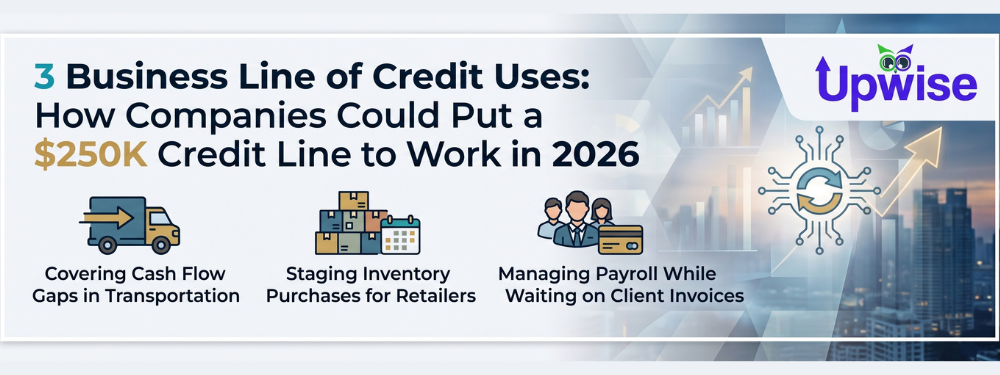

A new contract, a busy sales season, or a growing client account can be good news for a business—and still create a cash flow problem that a business line of credit can help solve. Expenses often arrive before customers pay. For small business owners who need to fund those expenses, a business line of credit may offer more flexibility than borrowing a lump sum.
This article will cover three practical business line of credit use cases, explain how a $250,000 credit line works, and provide actionable tips for applying these strategies in your business. It is designed for small business owners who want to better manage cash flow and seize growth opportunities. Understanding how business lines of credit function is essential for making informed decisions, maintaining financial stability, and positioning your company for success.
How does a $250,000 business line of credit work?
A business line of credit is a revolving financing product. A business line of credit is revolving and flexible. A lender approves a maximum amount, called the credit limit, and the business may draw funds up to its available limit, subject to the agreement. The maximum amount a lender allows you to borrow is called the credit limit. Unlike a term loan, which typically provides a lump sum for a defined purpose, a revolving business line lets the owner decide when and how much to draw. Available credit may replenish as borrowed amounts are repaid.
For example, if a company has a $250,000 limit and draws $75,000, it would have $175,000 in undrawn credit, assuming no other draws, fees charged against the limit, or restrictions. The $75,000 is debt that the business must repay; the unused $175,000 is not cash deposited into its checking account.
A line’s payment schedule matters as much as its limit. Some financing arrangements require weekly payments; others offer monthly payments. Draw availability, rates, fees, renewal requirements, and whether a rate is fixed or variable depend on the specific agreement. Business owners should review those terms before treating a credit line as part of their working capital plan.
Scenario 1: A trucking company covers the gap between deliveries and payment
The opportunity: More routes, more upfront expenses
Imagine a regional trucking company that wins a contract to run additional routes for an established customer. The projected revenue looks attractive, but completing the work requires the company to pay drivers, buy fuel, handle tolls, and keep trucks maintained before it receives payment.
The owner forecasts an $85,000 cash flow gap during the first several weeks of the contract. Even though the company has access to a hypothetical $250,000 business line of credit, it draws only the $85,000 needed for those expenses. It leaves $165,000 undrawn for other needs, subject to the lender’s terms.
When the customer pays its invoices, the company uses those receipts to make payments on the line. If a later contract creates another short-term gap, the owner can assess whether another draw makes financial sense.
Why flexible financing may fit
The trucking company’s need is tied to a specific source of expected revenue, but the timing of its cash going out does not match the timing of cash coming in. A line of credit may help bridge that gap without requiring the business to take a larger lump sum than it currently needs. Upwise lists cash flow management and operating expenses among common uses for a business line.
This is not a reason to borrow simply because a contract has been signed. The owner should check whether the expected profit will still justify the job after financing costs. A route that appears profitable before interest, fees, fuel changes, and unexpected repairs may look different after those costs are included.
The decision to make before drawing
The trucking company should ask:
- When will the customer actually pay not just when will the invoice be sent?
- How much cash must remain in the account for existing routes?
- Can the business make its required payments if the customer pays late?
- Would the contract still be worthwhile after the total cost of borrowing?
Practical takeaway
Practical takeaway: Use the credit line to support a defined, profitable job with a credible repayment source—not to cover a route that consistently loses money.
Scenario 2: A retailer purchases inventory in stages
The opportunity: Preparing for a seasonal rush
A retailer expects a strong year-end season but needs to order inventory months before all of it will sell. Buying too little could mean missed sales. Buying too much could leave cash tied up in merchandise.
The retailer has a hypothetical $250,000 small business line of credit and estimates that a full seasonal inventory plan could require $120,000. Instead of drawing the entire amount at once, the owner makes an initial $80,000 draw for products with a reliable sales history.
A few weeks later, sales data supports an additional $40,000 draw for items customers are buying quickly. At that point, the retailer has drawn $120,000 in total and has $130,000 of its original limit undrawn, assuming no repayments, additional draws, or restrictions.
Why a line of credit may fit inventory purchases
Inventory needs can change throughout a season. Revolving business credit allows the owner to make a purchasing decision when the need becomes clearer, rather than borrowing the entire forecast amount upfront. The U.S. Small Business Administration identifies seasonal increases in inventory and accounts receivable as financing needs that certain SBA-backed credit-line programs are designed to address.
There may be another opportunity: A supplier could offer a discount for an earlier or larger order. But a discount is valuable only if it exceeds the financing cost and the retailer can sell the goods at an acceptable margin. Buying slow-moving products merely to qualify for a discount can create a more expensive cash problem later.
The decision to make before drawing
Before each order, the retailer should estimate the product margin, likely sell-through, expected timing of customer payments, and total cost of the draw. It should also consider what happens if demand falls short.
The right solution could be a smaller draw, a revised inventory order, negotiated supplier terms, or no borrowing at all. Access to capital is useful when it supports a sound purchasing decision; it cannot turn unsold inventory into cash.
Practical takeaway
Practical takeaway: Draw in stages when possible, and let sales data not the full available credit limit guide purchasing.
Scenario 3: A staffing agency makes payroll while waiting on client invoices
The opportunity: A new client needs workers immediately
A staffing agency signs a contract to provide workers for a new client. The agency must meet payroll on its usual schedule, but it will collect payment from the client later. Taking on the account increases revenue, yet it also creates a temporary funding gap.
The agency estimates it needs $100,000 to cover wages and related operating expenses while the first invoices are outstanding. From a hypothetical $250,000 line, it draws $100,000 and leaves $150,000 undrawn, subject to the credit agreement.
When the client pays, the agency can use that cash toward repayment. If the account grows, the owner can revisit the forecast rather than assuming the original $100,000 draw will cover every future payroll cycle.
Why a business line may fit payroll timing
Payroll is predictable in one sense the agency knows when its team must be paid. Client payments can be less predictable. A line of credit may provide short-term working capital while the agency waits to collect receivables. Upwise identifies payroll coverage as a common use for its business line-of-credit options.
Still, recurring payroll should ultimately be supported by a healthy business model. If the agency must continually borrow more because clients pay too slowly or its margins are too thin, the line may be masking a structural problem rather than solving a temporary one.
The decision to make before drawing
The owner should review the client’s payment terms, the account’s projected margin, and how much payroll the agency could cover if an invoice is disputed or delayed. The team should also decide who will track outstanding invoices and when borrowed funds should be repaid.
Practical takeaway
Practical takeaway: Match each draw to a forecasted payroll gap and a realistic collection plan. Do not assume an unpaid invoice is the same as cash in the bank.
What do these three business line of credit uses have in common?
Trucking, retail, and staffing have different expense cycles, but each example starts with the same question: Will the expected cash arrive soon enough and in a large enough amount to repay what the business borrows?
Strategic debt can help a company act before revenue is collected. But borrowing is useful only when the expected value of the opportunity outweighs the cost and risk of financing. An approved credit limit is a maximum the lender allows the business to borrow; it is not a spending target.
For each potential draw, write down these four figures:
- Amount needed: The smallest draw that covers the identified gap.
- Expected cash-in date: When the business reasonably expects to collect from customers or clients.
- Total financing cost: Interest plus any applicable draw, maintenance, transaction, or other fees.
- Backup plan: How the business will make payments if revenue arrives late or falls short.
That exercise helps owners decide whether a line of credit provides genuine flexibility or simply adds debt to an already strained cash flow cycle.






Recent Comments