


















What is Gross Revenue: Understanding Your Business's Total Income

Navigate
Introduction to Gross Revenue
Gross revenue represents the total amount of money generated from all sales before any deductions are made. For business owners seeking to understand their financial performance, knowing what constitutes gross revenue is fundamental to making informed business decisions. This total revenue figure serves as the starting point for evaluating your company’s financial health and market demand for your products or services.
When examining financial statements, gross revenue appears at the top of the income statement, often called net sales when returns and allowances are subtracted. Understanding this metric helps small business owners and established companies alike gauge their sales volume and overall market position. The revenue generated through all business activities provides crucial insights into business performance and growth potential.
Understanding Gross Revenue vs Net Revenue
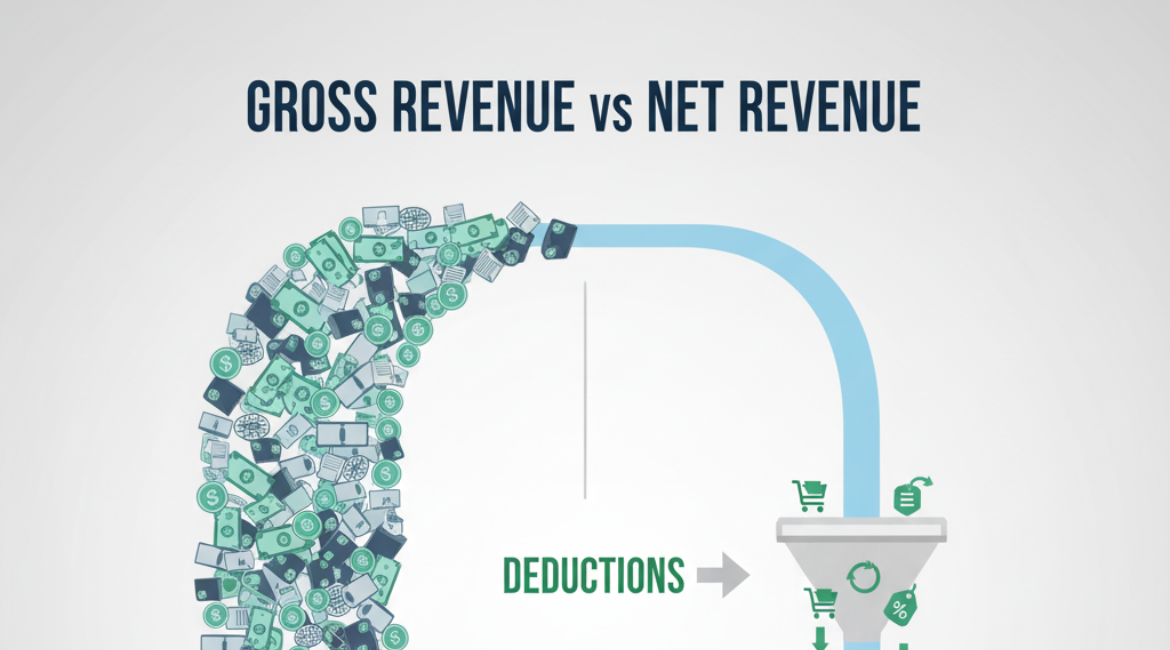
The difference between gross and net revenue is critical for accurate financial reporting. While gross revenue shows all the money coming into your business from goods sold and services sold, net revenue represents what remains after subtracting returns, allowances, and discounts. This distinction between gross revenue vs net figures helps paint a more accurate picture of your company’s true earnings.
Unlike gross revenue, which captures every dollar of sales, net revenue offers a clearer view of actual money generated from operations. For a software company, gross revenue might include all subscription fees, while net revenue accounts for refunds and promotional discounts. Net revenue reveals the actual revenue available for covering business expenses and generating profit.
Understanding gross and net revenue relationships enables better decision making about pricing strategies and cost management. When gross revenue is significantly higher than net revenue, it may indicate issues with product quality, customer satisfaction, or overly aggressive discounting that affects business’s profitability.
How to Calculate Gross Revenue
Learning to calculate gross revenue is straightforward: multiply the number of units sold by the price per unit. For service businesses, multiply billable hours by hourly rates or sum all service contracts. This calculation provides the total sales figure before any deductions.
Here’s the basic formula for gross revenue:
Product businesses: Price per unit × Number of units sold = Gross revenue
Service businesses: Sum of all services sold = Gross revenue
For example, if a company sells 1,000 products at $50 each, their gross revenue equals $50,000. This company’s total sales figure represents the total income before considering any direct costs or operating expenses. The simplicity of this calculation makes gross revenue an easily trackable metric for monitoring sales revenue trends.
Gross Revenue and Related Financial Metrics
Gross Profit and Gross Profit Margin
Gross profit emerges when you subtract cost of goods sold (COGS) from gross revenue. The gross profit margin, expressed as a percentage, indicates how efficiently a company produces goods sold. A healthy gross profit suggests effective cost management of direct costs associated with production.
The gross profit margin calculation helps business owners understand their operational efficiency. High gross revenue doesn’t automatically translate to high gross profits if direct expenses are poorly managed. Monitoring both gross income and gross profit provides insights into production efficiency and pricing effectiveness.
Net Profit and Net Profit Margin
Net profit represents what remains after subtracting all the expenses from total revenue. The net profit margin reveals the percentage of revenue that becomes net earnings. This metric demonstrates a company’s ability to generate income while managing all costs related to operations.
Net income differs from gross income by accounting for operating costs, administrative costs, and other expenses. The net profit margin provides business owners with insights into overall profitability and helps maintain profitability through strategic decision making.
The Importance of Tracking Both Metrics
Financial Health Assessment
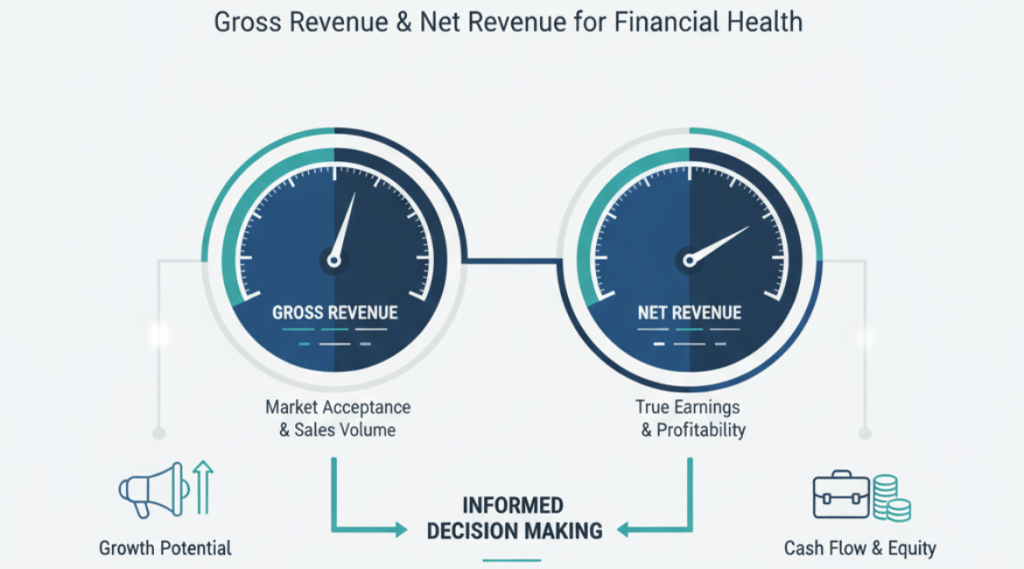
Monitoring both gross and net revenue provides comprehensive insights into your company’s financial health. Gross revenue indicates market acceptance and sales volume, while net revenue shows what the company retains after initial adjustments. Together, these metrics offer an accurate picture of financial performance.
Total revenue tracking helps identify trends in market demand and customer behavior. Regular analysis of gross revenue vs net revenue ratios can reveal issues with returns, discounts, or pricing that might otherwise go unnoticed. This dual tracking supports better financial reporting and strategic planning.
Cash Flow and Balance Sheet Impact
Understanding gross revenue impacts cash flow projections and balance sheet accuracy. While gross revenue might appear impressive, cash flow depends on net revenue and collection efficiency. The relationship between these metrics affects working capital and liquidity management.
Annual revenue figures, both gross and net, influence credit decisions and investor perceptions. Lenders and investors examine the difference between gross and net figures to assess business’s profitability sustainability. Strong gross revenue with poor net revenue might indicate operational inefficiencies requiring attention.
Key Differences in Business Applications
For Different Business Types
A software company might show high gross revenue from subscriptions but face significant net revenue reductions from free trials and refunds. Retail businesses see gross sales reduced by returns, while service businesses might have minimal difference between gross and net revenue.
Manufacturing companies must carefully track cost of goods sold against gross revenue to ensure profitable operations. Service providers focus more on operating expenses and other costs that impact the journey from gross revenue to net profit. Each industry has unique considerations affecting how gross revenue vs net metrics apply.
Decision Making and Strategy
Business owners use gross revenue data for market demand assessment and growth planning. High gross revenue trends suggest strong market position, while declining gross revenue signals potential issues requiring investigation. These insights drive business decisions about expansion, product development, and market positioning.
Net revenue guides pricing strategies and cost management initiatives. When net revenue significantly lags gross revenue, it triggers reviews of discount policies, return rates, and operational efficiency. This analysis supports decision making that balances growth with maintain profitability objectives.
Common Misconceptions About Revenue
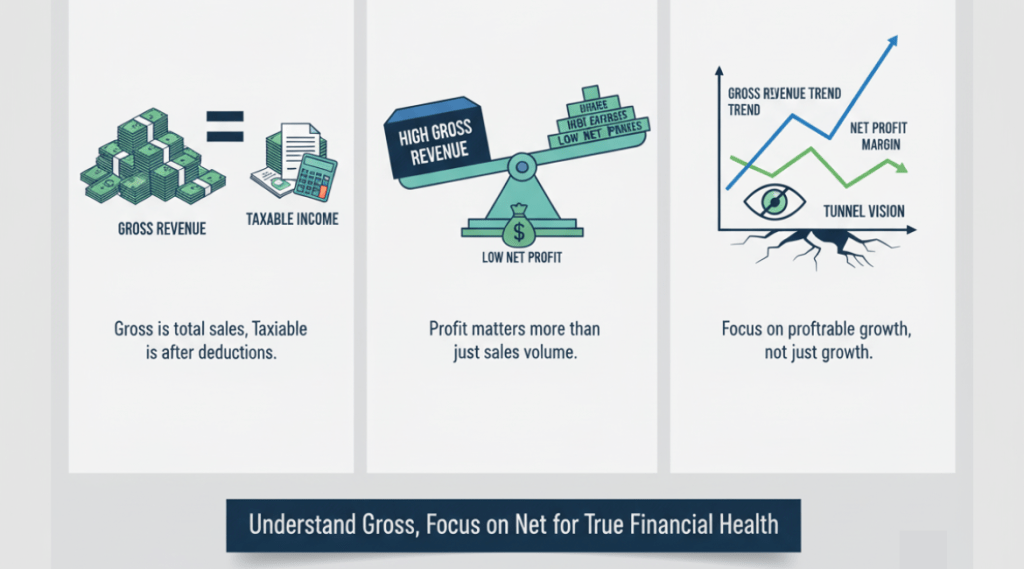
Many confuse gross revenue with taxable income, but they’re distinct concepts. Gross revenue includes all the money from sales, while taxable income comes after numerous deductions. Similarly, gross sales and gross revenue are often used interchangeably, though gross sales specifically refers to product sales.
Another misconception involves equating high gross revenue with success. A company showing substantial gross revenue might struggle with profitability if business expenses and operating costs are excessive. Net revenue and net profit provide better indicators of sustainable success than gross revenue alone.
Some business owners focus exclusively on gross revenue growth without considering margin implications. Increasing sales volume at the expense of profitability can damage long-term financial health. Understanding both gross and net revenue prevents this tunnel vision.
Using Revenue Metrics for Business Growth
Analyzing gross revenue trends helps identify successful products and services. By tracking which offerings contribute most to company’s total revenue, business owners can allocate resources effectively. This analysis of revenue generated by different segments informs strategic business decisions.
The gap between gross revenue and net revenue highlights improvement opportunities. Reducing this gap through better cost management, improved operational efficiency, and strategic pricing enhances overall profitability. Regular monitoring of both metrics ensures balanced growth strategies.
Calculate net revenue projections based on historical gross revenue patterns and expense ratios. This forecasting helps business owners plan for growth while maintaining healthy margins. Understanding these relationships enables proactive adjustments to maintain profitability during expansion phases.
Best Practices for Revenue Reporting
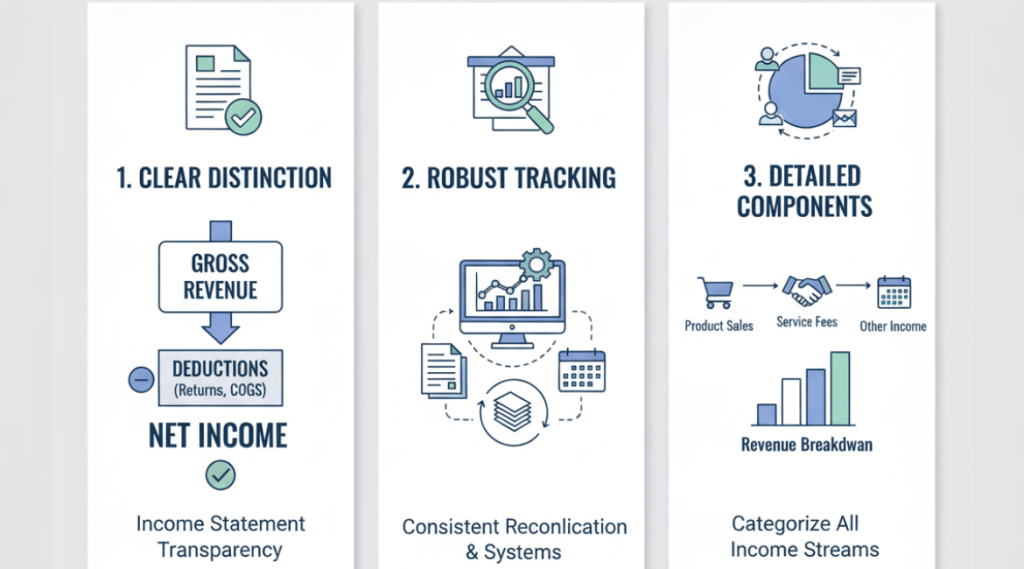
Accurate financial reporting requires clear distinction between gross and net revenue on financial statements. The income statement should clearly show the progression from gross revenue through various deductions to net income. This transparency aids stakeholder understanding and decision making.
Regular reconciliation ensures gross revenue figures match source documents and sales records. Implementing robust tracking systems prevents errors that could misrepresent company’s total revenue. Consistent financial reporting methods across periods enable meaningful comparisons of business performance.
Document the components of gross revenue, including product sales, service fees, and other income streams. This detailed tracking supports analysis of revenue sources and their relative profitability. Clear categorization helps identify which areas drive total income growth.
Conclusion
What is gross revenue? It’s the foundation of financial analysis, representing total sales before any deductions. Understanding the relationship between gross and net revenue empowers business owners to make informed decisions about pricing, operations, and growth strategies. While gross revenue shows market activity and sales volume, net revenue reveals true business viability after accounting for returns and allowances.
Success requires monitoring both metrics as part of comprehensive financial performance evaluation. Gross revenue indicates market acceptance and growth potential, while net revenue demonstrates actual money available for operations and expansion. Together, these metrics provide the accurate picture needed for strategic planning and maintain profitability.
By mastering these concepts and implementing proper tracking systems, business owners can optimize their operations, improve decision making, and build sustainable enterprises. Whether you’re evaluating annual revenue targets or daily sales revenue, understanding the distinction between gross and net revenue remains fundamental to business’s profitability and long-term success.
Our team at Upwise Capital is here to assist you with every step of the way to secure whatever funding is needed to help your business grow. If you have any questions regarding how financing works, please call our team at 77-55-UPWISE or email [email protected]. You can also apply online for financing, so you can get back to work and running your business.
So…What do you think?
We want to hear from you. What do you think of this article and was it helpful in your search for understanding what is gross revenue?
Let us know by leaving a reply below. Feel free to share this article on your social media.
SHARE
Recent Comments
 | VideoBGRemover on AI Tools for Small Business: W… |
| Tax Accounting on What is Gross Revenue: Underst… |
 | Rahul Gupta on Business Loan with Bank Statem… |
 | Joe on How Cannabis MCA Funding Can H… |
 | John on Opening a dispensary? See how… |
Other Articles You May Want to Read






One Comment
Good read! The difference between gross and net revenue is easy to overlook. Looking at both can give a much clearer picture of whether sales growth is actually translating into stronger business performance.