
















Colorado cannabis industry operators need capital for cultivation technology, manufacturing systems, retail buildouts, security, and expansion. Colorado cannabis equipment financing can help a licensed business acquire equipment without using cash needed for payroll, inventory, taxes, rent, and daily operations. The right structure may be an equipment loan, equipment leasing, a term loan, or a business line of credit.
What Is Colorado Cannabis Equipment Financing?
Cannabis equipment financing is business financing used to purchase or refinance machinery, fixtures, technology, vehicles, and other assets in a licensed operation. The equipment may serve as collateral, creating a different loan structure than unsecured working capital. Upwise Capital’s cannabis equipment financing can cover up to 100% of new or used equipment value, with terms of one to ten years or the expected life of the equipment, and funding potentially available in as little as two days.
Equipment Loans
Equipment loans let a business purchase an asset and repay it over a defined term. The borrower generally owns the equipment, and the lender may file a lien against it. Fixed-rate or fixed-payment structures may help operators forecast debt service and protect cash flow.
Equipment Leasing
Equipment leasing can reduce upfront cash requirements. Instead of paying the full purchase price or a large down payment, the business makes scheduled payments. Leasing can work well for machinery or technology that may need periodic upgrades.
Business Equipment Loans vs. Bank Credit Lines
Business equipment loans are built around a specific purchase, while bank credit lines provide revolving capital. A line of credit may fit inventory, payroll, repairs, and recurring expenses; equipment financing is generally better for a defined asset.
Why Cannabis Businesses Finance Equipment
A cannabis business can be profitable and still face cash flow pressure. Expansion often requires large purchases before equipment produces revenue.
Preserve Working Capital
Financing can preserve working capital for inventory, payroll, rent, utilities, licensing, and marketing, which is especially valuable for a cannabis business that depends on reliable tools to keep sales and compliance on track. Rather than tying up money in one purchase, the business can spread payments over time and help ensure the business runs smoothly.
Match Payments to the Asset
A well-designed financing structure aligns the term with the useful life of the equipment. Long-life assets such as HVAC systems, extraction machinery, commercial ovens, packaging lines, and cultivation equipment may support terms running several years.
Move Faster on Growth and Upgrades
When a critical machine fails or a new location is opening, an operator may not want to wait weeks for a traditional bank process. Specialized financing solutions can move faster when the business has established revenue, organized financial records, and a clear vendor quote.
Equipment Eligible for Financing
Cannabis equipment loans can be used across cultivation, processing, manufacturing, testing, distribution, and retail operations. Eligibility depends on the lender, equipment value, business use, licensing, installation requirements, and whether the asset can be identified and documented.
- Cultivation equipment: grow lights, irrigation and fertigation systems, grow tables, HVAC, ventilation, dehumidification, filtration, environmental controls, water treatment, drying and curing systems, and tools used to manage marijuana plants.
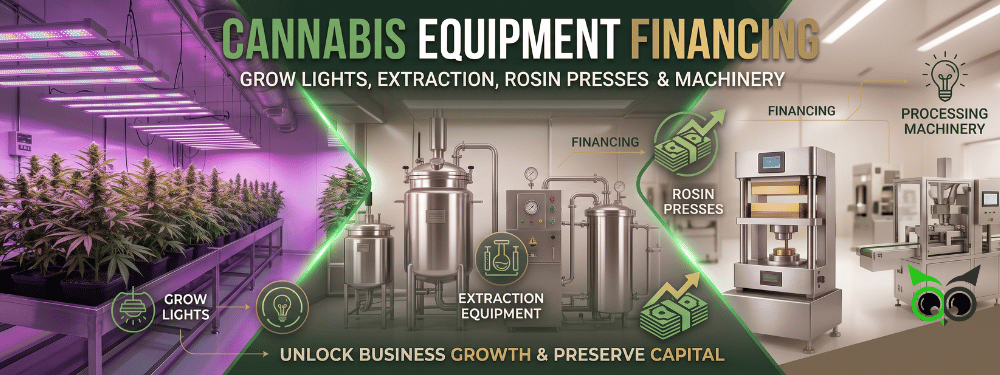
- Extraction and manufacturing equipment: extraction systems, rosin presses, distillation and filtration systems, commercial ovens, mixers, infusion equipment, refrigerators, freezers, filling machines, labeling systems, and packaging lines.
- Dispensary equipment: point-of-sale hardware, display cases, secure storage, scales, barcode scanners, cash-counting machines, kiosks, refrigeration, and retail software or inventory-management hardware.
- Security and compliance equipment: surveillance cameras, NVRs, access control, alarms, safes, vaults, ID scanners, backup power, networking equipment, and seed-to-sale tracking hardware.
- Laboratory equipment: chromatography systems, mass spectrometry systems, microscopes, sample-preparation equipment, refrigeration, ventilation, and calibration tools.
- Vehicles and transportation equipment: eligible delivery vehicles, vans, trucks, fleet equipment, and specialized transportation assets, subject to lender and regulatory requirements.
- Energy-efficiency equipment: efficient lighting, HVAC replacements, automated environmental controls, water-saving systems, insulation, and certain renewable-energy or power-management upgrades.
Colorado has published cannabis environmental guidance covering energy efficiency, water use, HVAC, lighting, and renewable-energy considerations for cultivation operations.
How Lenders Underwrite Cannabis Equipment Financing
A lender usually evaluates both the business and the asset. Strong equipment value can support a transaction, but the business still must demonstrate the ability to make payments and operate legally.
Cash Flow and Debt Service
Lenders review revenue, deposits, existing debt, profitability, and recurring obligations to determine whether cash flow can support the proposed payment. Debt-service coverage matters when a business already has term debt, merchant financing, real estate debt, or other equipment loans.
Credit Report and Business History
A lender may review the owners’ credit report, business credit, time in business, payment history, liens, tax returns, bank statements, and financial statements. Stronger credit and a longer operating history can improve available financing options.
Equipment Value, Down Payment, and Liens
Underwriters consider purchase price, resale value, useful life, vendor quality, installation costs, and whether the asset is new or used. Some transactions may finance up to 100% of value, while others require a down payment. Borrowers should confirm whether the lender takes a lien only on the asset or broader blanket liens.
AI-Assisted and Automated Underwriting
Modern business financing increasingly uses AI-assisted document analysis, automated bank-statement review, cash-flow analytics, machine-learning risk models, digital identity verification, predictive risk scoring, and real-time financial data to organize information and speed preliminary credit decisions.
AI does not replace underwriting. It can identify trends, flag missing documents, and accelerate eligibility reviews, while final approval still depends on lender policy, the equipment, and the business.
How Fast Can Equipment Financing Be Approved?
Speed varies by transaction. Smaller purchases with clean bank statements and a clear invoice may move quickly, while larger installations, used equipment, startups, or complex collateral can require more diligence.
Some business lenders advertise same-day decisions, but approval does not always mean cash arrives the same business day because the lender must review the asset and vendor. Upwise’s current cannabis equipment financing page advertises funding as fast as two days, subject to approval and documentation. Upwise Capital
Colorado Marijuana Laws and Financing
Colorado’s cannabis market operates under state and local regulation. Colorado voters approved Amendment 20 for medical marijuana in 2000 and Amendment 64 for adult-use marijuana in 2012. The Marijuana Enforcement Division within the Colorado Department of Revenue regulates licensed marijuana businesses, while the Colorado Department of Public Health and Environment publishes public health guidance.
Retail Marijuana, Medical Marijuana, and State Law
Retail marijuana and medical marijuana operate under different rules. The Marijuana Enforcement Division helps regulate licensed marijuana businesses, and Denver has also played a major role in Colorado’s cannabis legal evolution and local regulation. A financing provider may request licenses, ownership information, location approvals, entity documents, and evidence that the equipment will be installed and used within a properly licensed operation, while some employers or property owners may still prohibit marijuana use or possession despite state-level legality.
Purchase, Possession, and Cannabis Use Rules
Under Colorado’s current guidance, adults 21 and older can purchase marijuana only from licensed retail stores, with up to one ounce of retail cannabis purchased at a time, and may possess up to two ounces. Public cannabis use, including smoking, eating, or vaping, is illegal, and cities and other local governments may impose stricter rules. State authorization of marijuana use does not prevent private landlords, employers, or other parties from setting their own restrictions where allowed. Cannabis and alcohol are also governed through separate Colorado regulatory frameworks.
Federal Law Still Affects Financing
Cannabis may be legal under Colorado state law while remaining restricted under federal law, and marijuana use is limited to private settings where state rules allow it. That difference affects banking, payments, lender due diligence, access to conventional bank credit lines, and can make cannabis real estate financing through asset-based loans an important option for some operators. A simple intake form often helps providers review compliance details without slowing financing discussions for clients. FinCEN guidance for financial institutions serving marijuana-related businesses includes verifying state licensing and understanding expected account activity. Public use is generally prohibited. Cannabis may also be consumed at state-licensed hospitality businesses or tasting rooms where permitted. Possession limits still apply under Colorado law. Home cultivation is allowed for up to 6 plants per adult under current Colorado rules. Retail sales also require cannabis products to be sold in child-resistant, resealable packaging. Earlier enforcement could still lead to fines or even jail, which helps explain why federal scrutiny remains relevant. Driving under the influence of cannabis is illegal in Colorado.




Recent Comments