











Federal hemp regulations and industry growth header

Federal Hemp Regulations: How the Lawful Hemp Protection Act Could Affect Inventory, Cash Flow, and Business Financing

Navigate

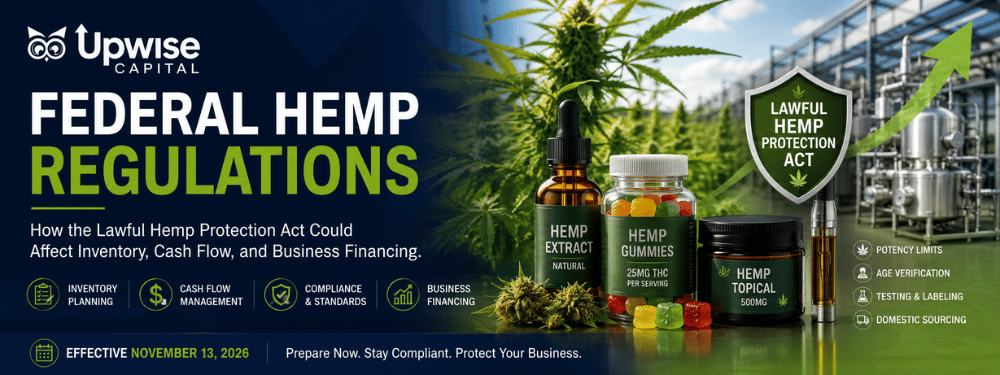
The U.S. hemp industry is preparing for a potentially significant regulatory shift, and the clearest answer to the current debate over hemp regulations is this: the bipartisan Lawful Hemp Protection Act would replace an approaching federal restriction with a nationwide framework for hemp-derived consumer products, setting rules for potency, manufacturing, testing, labeling, age verification, taxation, and distribution beginning November 13, 2026.

For hemp farmers, cannabinoid manufacturers, beverage producers, distributors, retailers, and other hemp business owners, those federal hemp regulations are not a policy abstraction. They can directly change product legality, inventory planning, supplier relationships, compliance expenses, cash flow, and access to working capital and business financing. Introduced on July 22, 2026, by Representatives Andy Barr of Kentucky and Angie Craig of Minnesota, the bill would preserve a large portion of the hemp-derived cannabinoid market while creating a federally regulated market for products that now face legal uncertainty.

That makes this a practical business issue as much as a legal one. The changes under proposed hemp industry regulations could reshape hemp beverage distribution models, increase compliance costs, affect inventory and supply-chain decisions, and influence whether businesses qualify for financing as they adapt. This overview explains what the Lawful Hemp Protection Act would do, how it could affect operations and cash flow, what hemp companies can do now to prepare, and where financing options such as Upwise Capital may fit if regulatory shifts put pressure on inventory, liquidity, or growth plans.

What Is the Lawful Hemp Protection Act for the Cannabis Sativa Plant?

The Lawful Hemp Protection Act is a bipartisan proposal designed to repeal a restrictive federal hemp provision scheduled to take effect on November 13, 2026.

Under the FY2026 Agriculture Appropriations Act, that provision would limit finished hemp products to 0.4 milligrams of total THC per container. Hemp industry organizations have warned that this threshold could make many products currently sold in the United States federally noncompliant, including some industrial hemp items tied to cultivation, processing, manufacturing, and sale requirements.

Instead of allowing this broad restriction to take effect, the new bill proposes a regulated market with specific federal standards. Its key provisions include:

  • Increasing the plant-level threshold to 1% total THC by dry weight
  • Establishing separate categories for industrial and consumable hemp
  • Directing the FDA to set THC serving limits
  • Restricting hemp-derived cannabinoid products to adults 21 and older
  • Prohibiting marketing designed to appeal to children
  • Banning synthetic and laboratory-modified cannabinoids
  • Requiring covered products to be grown, processed, and packaged in the United States
  • Creating federal testing, labeling, manufacturing, and packaging standards

If the FDA does not establish serving limits within one year, the bill would impose default limits of 5 milligrams of THC per serving for ingestible products and 50 milligrams for vape and topical products.

These requirements could create a more predictable legal market, but they may also generate substantial hemp compliance costs for businesses.

How Federal Regulations on Hemp Could Affect Business Inventory
Federal hemp regulations and industry growth supply chain

Inventory planning is one of the most immediate concerns created by regulatory uncertainty.

Hemp businesses must decide how much raw material, packaging, and finished product to purchase before the November 13 deadline. Ordering too much could leave a company holding products that cannot legally be sold. Ordering too little could result in shortages if Congress replaces the restriction with a regulated-market approach.

Federal hemp regulations could affect:

  • Raw hemp and cannabinoid purchases
  • Finished-product inventory
  • Beverage manufacturing schedules
  • Packaging and labeling supplies
  • Retail purchasing commitments
  • Warehouse capacity
  • Online product catalogs
  • Wholesale distribution agreements

Companies may want to classify products according to their potential regulatory exposure. Items containing synthetic or modified cannabinoids, for example, could face greater compliance challenges under the proposed law.

Businesses can also review expiration dates, inventory turnover, supplier lead times, and outstanding purchase commitments. The goal should be to maintain enough inventory to support operations without tying up excessive capital in products that could become noncompliant.

Domestic Hemp Program Supply Chains and Crop Insurance May Become More Important

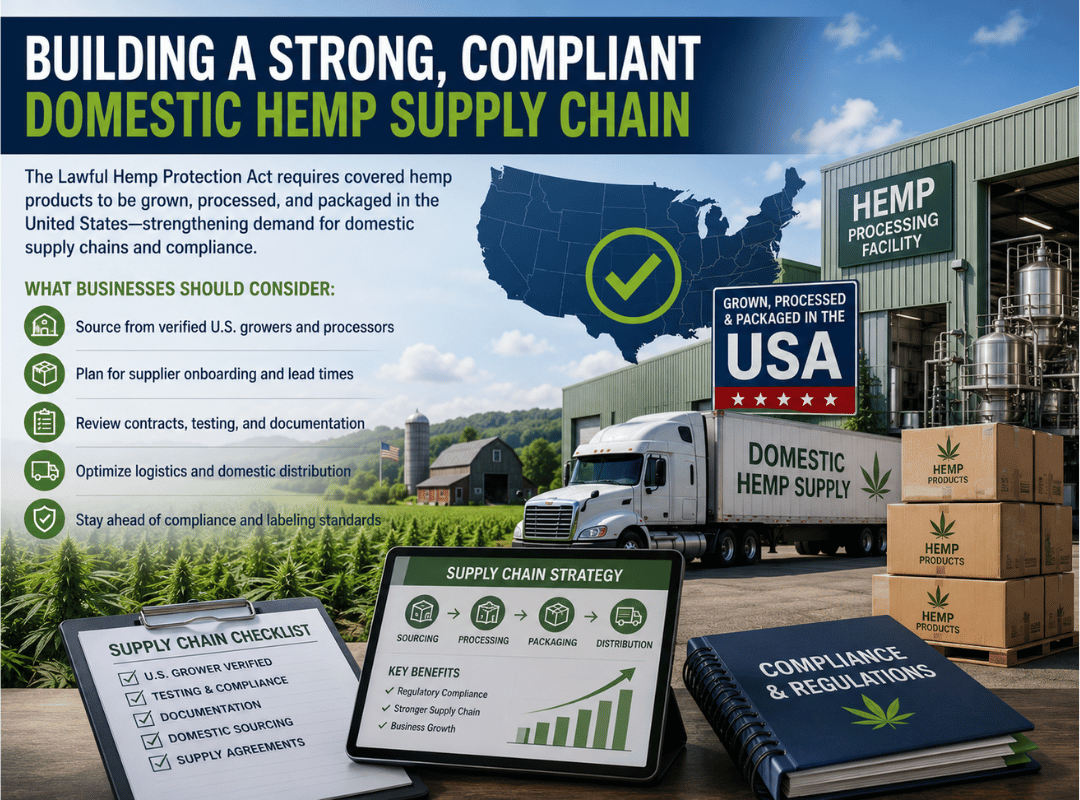
The Lawful Hemp Protection Act would require covered hemp products to be grown, processed, and packaged in the United States.

This domestic sourcing requirement could reshape the hemp supply chain. Interstate transportation of legal hemp is generally protected under the 2018 Farm Bill, even if sourcing and processing rules still change by country. Businesses that rely on international ingredients, processing facilities, or packaging vendors may need to identify new U.S.-based partners.

Switching to domestic hemp suppliers may involve:

  • Higher initial purchasing costs
  • New supplier deposits
  • Different minimum-order quantities
  • Longer onboarding and verification procedures
  • Revised manufacturing agreements
  • Additional product-testing requirements
  • Changes to shipping and fulfillment operations

Companies should evaluate whether current suppliers can satisfy the proposed standards. They should also identify alternative vendors rather than waiting until federal rules are finalized.

If demand for compliant U.S.-grown and U.S.-processed hemp increases quickly, domestic suppliers could experience capacity constraints. Early supply-chain planning may help businesses avoid delays and unexpected price increases.

Testing, Packaging, and Labeling Could Increase Hemp Compliance Costs

More comprehensive federal hemp regulations could bring greater legal certainty, but compliance may require meaningful investment and stricter enforcement.

Hemp manufacturers and retailers could need to redesign labels, replace packaging, strengthen age-verification procedures, conduct additional laboratory tests, reformulate certain products, and complete any required registration, and many plant-touching operators evaluate cannabis equipment financing strategies to spread the cost of new machinery over time.

Potential hemp compliance expenses include:

  • Third-party laboratory testing
  • New packaging and labels
  • Product reformulation
  • Manufacturing equipment
  • Inventory-tracking technology
  • Quality-control procedures
  • Age-verification systems
  • Employee compliance training
  • Legal and regulatory consulting
  • Supplier certification and documentation

Businesses should be cautious about placing large orders for custom packaging before confirming that the designs will meet future federal standards. Flexible contracts and smaller production runs could reduce the risk of accumulating unusable packaging. Businesses that rely on international ingredients, processing facilities, or packaging vendors may need to identify new U.S.-based partners, since rules can vary by country.

Hemp Beverage Regulations Could Reshape Distribution

Hemp-derived beverages would receive separate treatment under the proposed law.

The bill would place hemp beverages under the Alcohol and Tobacco Tax and Trade Bureau and introduce a three-tier distribution model separating manufacturers, wholesalers, and retailers, allowing states that have legalized these products to regulate how they are sold and serve them much like alcohol. It would also establish an excise tax of five cents per milligram of THC, and the minimum age to purchase these intoxicating products would remain 21 years old.

These proposed hemp beverage regulations could affect companies that currently sell directly to retailers or consumers. Beverage brands may need to establish relationships with licensed wholesalers and revise their pricing, territory, delivery, labeling, packaging, testing, reformulation, and registration strategies.

The hemp beverage marketplace grew 143% in 2023.

A three-tier model could influence:

  • Wholesale pricing
  • Retail profit margins
  • Distributor fees
  • Delivery schedules
  • Geographic expansion
  • Sales-tax and excise-tax administration
  • Direct-to-consumer sales
  • Working-capital requirements

Stronger federal standards would likely raise enforcement expectations for manufacturers and retailers.

Hemp beverage companies should model how additional distribution costs and taxes could influence product pricing. They may also need more capital to produce inventory before receiving payment from wholesalers or retailers. If federal definition changes take effect in 2026, much of the hemp beverage market could be eliminated, though it could still account for near-term planning pressure, raising the stakes for distribution and pricing decisions.

Apply Now for a Loan Today!

Upwise Capital Logo

Why Regulatory Change Can Create Cash-Flow Challenges

Federal hemp regulations and industry growth protect cash flow

Even if the Lawful Hemp Protection Act creates long-term stability, the transition may place short-term pressure on business cash flow.

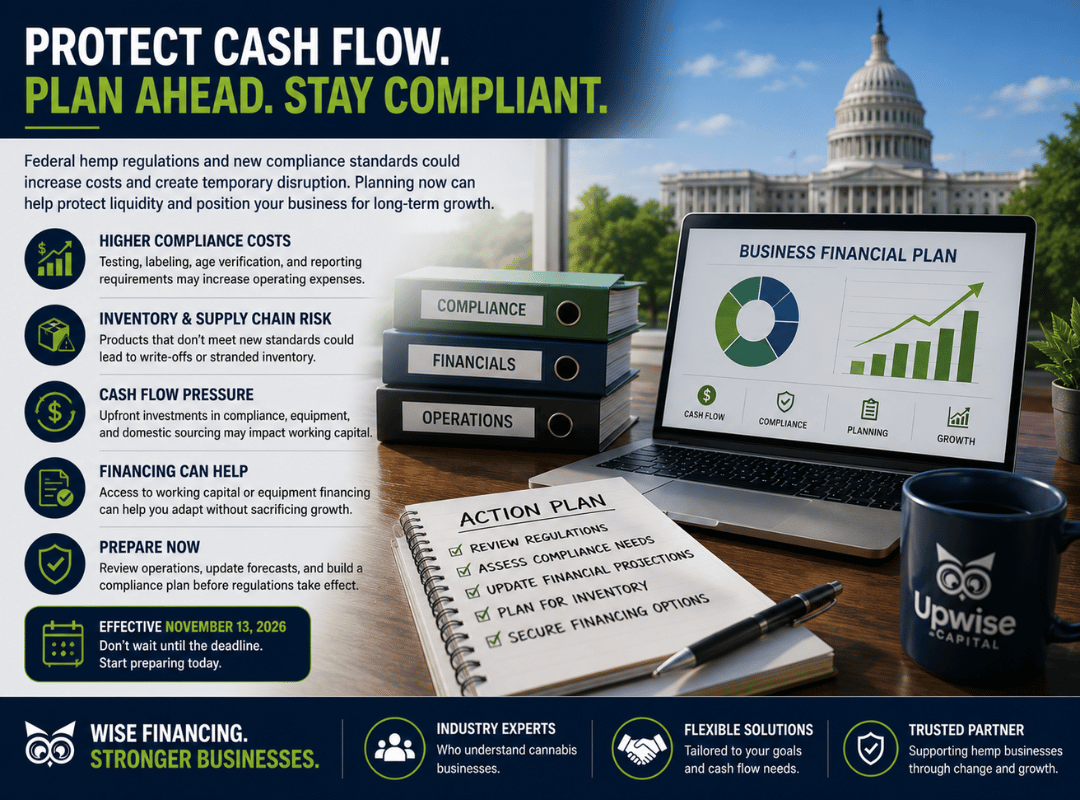
Companies could have to invest in testing, packaging, equipment, and compliant inventory for intoxicating hemp products before generating sales from updated products. At the same time, they must continue paying ordinary operating expenses such as payroll, rent, utilities, marketing, insurance, and supplier invoices, while compliance costs may also affect how businesses can serve wholesale and retail channels.

Common cash-flow challenges may include:

  • Replacing noncompliant inventory
  • Paying deposits to new domestic suppliers
  • Funding packaging redesigns
  • Purchasing compliant manufacturing equipment
  • Managing slower inventory turnover
  • Covering testing and certification costs
  • Absorbing higher production expenses
  • Meeting tax and distribution obligations

Maintaining sufficient liquidity may help a hemp business respond to regulatory changes without interrupting daily operations and stay active in a regulated marketplace, and in some cases that may involve project-based funding such as cannabis facility construction financing when expansion or retrofitting is part of the compliance plan.

What Is Hemp Inventory Financing?

Hemp inventory financing refers to business funding used to purchase raw materials, finished products, packaging, or other inventory-related items.

Inventory financing may help eligible hemp companies prepare for seasonal demand, replace products, change suppliers, or transition to compliant inventory. Depending on the business and the financing provider, available options may include term financing, lines of credit, revenue-based financing, or equipment financing, and some operators look at cannabis business loan programs structured specifically for regulated-plant businesses.

The right option will depend on factors such as:

  • Monthly business revenue
  • Time in business
  • Personal and business credit
  • Cash-flow consistency
  • Requested funding amount
  • Intended use of funds
  • Existing debt obligations
  • Lender industry restrictions

Because cannabis- and hemp-related businesses can face additional underwriting limitations, funding availability should never be assumed. Owners should provide accurate information about their products, operations, revenue, and licensing status when exploring financing.

Can Hemp Businesses Qualify for Business Financing?

Some hemp businesses may qualify for financing, although eligibility depends on the company’s profile and the requirements of individual funding providers.

Potential funding uses may include, especially when businesses explore cannabis working capital loan solutions designed for ongoing operational expenses:

  • Purchasing compliant inventory, including via cannabis term loan financing when long-term funding aligns with projected cash flow
  • Acquiring equipment
  • Updating packaging and labeling
  • Paying for product testing
  • Expanding domestic supply chains
  • Supporting payroll and operating expenses
  • Renovating production or retail facilities
  • Funding marketing and customer acquisition

Business owners should understand the cost, repayment structure, term, and cash-flow impact of any financing arrangement before accepting an offer.

Financing should be used as part of a deliberate business plan—not as a substitute for addressing ongoing profitability or compliance problems.

How Hemp Businesses Can Prepare for New Regulations

Hemp farmers, manufacturers, distributors, and retailers should prepare for more than one legislative outcome. The Lawful Hemp Protection Act has bipartisan sponsorship, but it must still advance through Congress.

A practical hemp compliance plan may include the following steps:

1. Audit Current Products

Identify products that could be affected by new THC limits, testing standards, or restrictions on synthetic and modified cannabinoids.

2. Review Inventory Exposure

Calculate how much potentially noncompliant inventory the business is holding and how long it will take to sell through it.

3. Evaluate Suppliers

Determine whether existing suppliers can satisfy possible U.S. cultivation, processing, packaging, and documentation requirements, including whether they operate under a USDA-approved state or tribal plan where cultivation licensing applies and can meet reporting duties tied to the relevant hemp program.

4. Limit Risky Purchase Commitments

Avoid unnecessary long-term orders for packaging or products that could become noncompliant, including commitments tied to unapproved extraction or processing arrangements, especially when hemp is extracted under methods that may also trigger agriculture reporting requirements, including FSA acreage filings where applicable, and reporting for each cultivation site before renewal or continued participation.

5. Estimate Compliance Expenses

Prepare a budget for testing, reformulation, packaging, equipment, software, legal guidance, and employee training.

6. Build a Cash Reserve

Preserve liquidity for unanticipated changes, supplier delays, or temporary interruptions in sales.

7. Explore Hemp Business Financing Early

Businesses that may require capital should review potential options before expenses become urgent. Early preparation can provide more time to compare costs and terms.

8. Seek Professional Guidance

Owners should consult qualified legal, tax, and regulatory professionals before changing products, contracts, or distribution practices, and check the relevant department website for additional information before making changes.

How Upwise Capital Supports Business Owners

Regulatory transitions can require companies to make investments before the financial benefits become clear. A hemp-related business may need capital for new inventory, testing, packaging, equipment, supplier deposits, or day-to-day operating expenses, and some owners consider flexible small business financing options that can be tailored to evolving operational needs.

Upwise Capital helps business owners explore business financing solutions based on their qualifications, cash flow, and objectives. While approval is not guaranteed and hemp-related businesses may be subject to additional eligibility restrictions, qualified companies may be able to consider funding solutions suited to their operational needs.

Upwise Capital can help eligible business owners assess financing for a range of needs, and those ready to pursue options can begin with a streamlined Upwise funding application:

  • Inventory purchases
  • Equipment and technology
  • Packaging and labeling updates
  • Supply-chain expenses
  • Business expansion
  • Working capital
  • Other qualified business purposes

The best financing option depends on the company’s financial condition, funding purpose, repayment capacity, and industry classification.

Preparing Your Hemp Business for What Comes Next

The ongoing debate over federal hemp regulations could determine the future of a large U.S. consumer market. Whether lawmakers pass the Lawful Hemp Protection Act, allow the existing restriction to take effect, or adopt another approach, hemp businesses should begin preparing now, including understanding specialized cannabis and CBD financing options that may support long-term growth.

Reviewing inventory, assessing domestic suppliers, estimating compliance costs, and developing a cash-flow plan can help companies reduce unnecessary risk. Exploring hemp business financing before a major expense arises may also provide more flexibility during the transition.

For hemp business owners, preparation is no longer limited to regulatory compliance. It is also about protecting inventory, preserving working capital, and creating a financial strategy that can adapt to a changing market.

Frequently Asked Questions About Hemp Business Financing and Regulation

What is the Lawful Hemp Protection Act?

Federal law defined hemp as the cannabis sativa plant, Cannabis sativa L., with no more than 0.3% THC on a dry weight basis. The Lawful Hemp Protection Act is a bipartisan federal proposal that would repeal an approaching restriction on hemp-derived cannabinoid products and replace it with rules covering potency, manufacturing, testing, labeling, age restrictions, taxation, and distribution.

When is the federal hemp restriction scheduled to take effect?

The restriction discussed in the proposed legislation is scheduled to take effect on November 13, 2026, unless Congress changes the law.

How could federal hemp regulations affect small businesses?

New regulations could require small businesses to replace inventory, reformulate products, redesign packaging, conduct more testing, update age-verification systems, or change suppliers and distributors, and some state laws also impose specific operational deadlines and permit rules. For businesses growing hemp in Georgia, the Hemp Farming Act passed in 2019, a grower license is renewed annually, and processors need a Hemp Processor Permit. Licensed growers are required to report harvests by December 1 each year, and hemp crops must be tested for THC levels within 15 days of anticipated harvest.

What is hemp business financing used for?

Eligible businesses may use financing for inventory, equipment, packaging, laboratory testing, supplier expenses, expansion, or working capital. Some hemp businesses also look at crop insurance and federal risk-management program options alongside financing. Permitted uses and eligibility vary by provider. Hemp crop insurance is available in 27 states, including california, nevada, north dakota, oregon, south dakota, and not mexico, and Multi-Peril Crop Insurance can cover hemp grown for fiber, grain, or cbd depending on the variety. Whole-Farm Revenue Protection is available nationwide. Nursery crop insurance may apply in some cases, and the Noninsured Crop Disaster Assistance Program can help protect against crop losses.

Does Upwise Capital offer guaranteed hemp business loans?

No financing approval should be considered guaranteed. Availability depends on the applicant’s qualifications, business activities, financial condition, and the requirements of participating funding providers.

Should businesses obtain legal advice about the proposed hemp rules?

Yes. Hemp and cannabinoid regulations are complex and can vary by federal, state, and local jurisdiction. Business owners should consult qualified legal and regulatory professionals regarding their specific operations and contact the relevant state or federal agency page for official guidance specific to their operations.

SHARE

Take advantage of an 85% approval rate - act now!

Match with the perfect loan for your business.

Name(Required)

Leave a Reply

Your email address will not be published. Required fields are marked *

Other Articles You May Want to Read