













Commercial lending rate

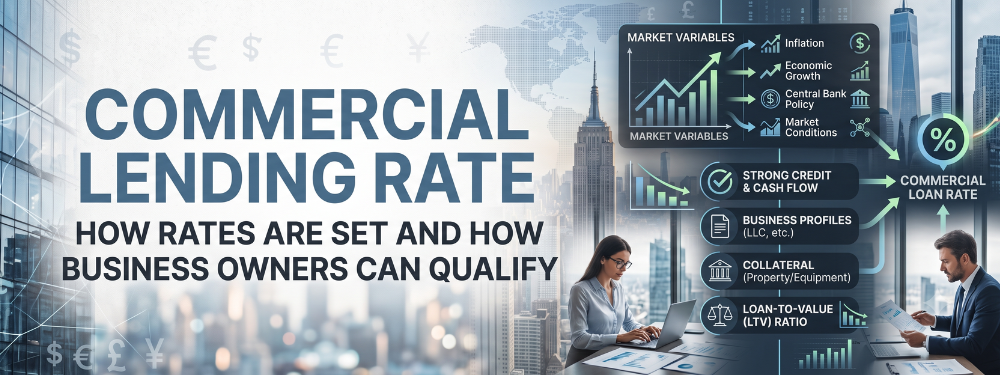
Commercial Lending Rate: How Rates Are Set and How Business Owners Can Qualify

Navigate

What Is a Commercial Lending Rate?

A commercial lending rate is the cost a business pays to borrow money through commercial loans, including commercial real estate loans, equipment financing, working capital lines, bridge loans, CMBS loans, and SBA financing. For a business owner, the commercial lending rate directly affects the monthly payment, total interest expense, and long-term cash flow.

Unlike personal loans, commercial loans are priced around the borrower’s credit, the strength of the business, the quality of the collateral, the loan amount, the type of property, and current market conditions. A strong borrower with stable cash flow, clean credit history, strong business credit scores, and a conservative loan to value ratio may qualify for a lower rate. A borrower with higher leverage, limited operating history, or a higher risk profile may pay a higher interest rate.

Why Commercial Lending Rates Matter

Higher interest rates increase payments and can reduce operating margins. For any business, the rate is not just a financing detail. It is a strategic cost of capital.

A small difference in commercial lending rate can impact:

The ability to purchase a commercial property

The feasibility of a refinance

The debt service on commercial real estate

The amount of available cash flow

The total cost of long-term financing

The strength of a loan request

The borrower’s ability to meet underwriting standards

For example, a business evaluating a commercial mortgage should not only look at the rate. The full deal includes the loan terms, amortization, fees, down payment, prepayment penalties, possible balloon payment, and lender structure.

What Determines a Commercial Lending Rate?

Commercial lending rates are driven by two major categories: macroeconomic benchmarks and borrower-specific risk.

The benchmark side includes the federal funds rate, prime rate, Treasury yields, and the secured overnight financing rate. These indices reflect the broader market cost of money. The borrower side includes credit history, business credit scores, revenue, cash flow, collateral, property type, industry risk, and management experience.

Most commercial loans are priced off a base rate plus a spread. That spread is how lenders account for risk, operating costs, profit, regulatory capital requirements, and the complexity of the deal.

A simplified formula looks like this:

Commercial lending rate = benchmark index + lender spread + risk premium + fees

Different financial institutions may price the same loan differently because each bank or lender has its own cost of funds, balance sheet strategy, underwriting standards, and appetite for certain industries.

Key Benchmarks: Prime Rate, SOFR, Federal Funds Rate, and Treasuries

Many commercial loans are tied to a benchmark. The most common benchmarks include the prime rate, the secured overnight financing rate, the federal funds rate, and Treasury yields.

The prime rate is commonly used for floating-rate business loans, SBA loans, lines of credit, and some bank financing. As of June 2026, major bank prime rate sources show the U.S. prime rate at 6.75%, not 7.00%. JPMorgan Chase lists 6.75% effective December 11, 2025, and Bank of America also lists its prime rate at 6.75%.

The federal funds rate influences short-term borrowing costs. As of June 17, 2026, the target range for the federal funds rate was listed at 3.50% to 3.75%, with the prime rate remaining at 6.75%.

The 10-year Treasury is commonly watched for longer-term commercial mortgage rates. Recent market data showed the 10-year Treasury around the mid-4% range in late June 2026, with FRED showing 4.50% on June 23, 2026, and market reporting showing the yield near 4.39% to 4.40% on June 25, 2026.

The secured overnight financing rate, often referred to as SOFR, is also used for floating-rate commercial loans, especially after LIBOR was phased out. When SOFR moves, variable-rate commercial debt can adjust, increasing or decreasing the borrower’s payment.

Current Commercial Mortgage Rates

Commercial mortgage rates move based on market conditions, property type, loan size, borrower strength, and leverage. As of June 25, 2026, one commercial mortgage rate source showed average commercial rates ranging from approximately 5.37% to 8.75% for conventional loans, 5.75% to 8.75% for SBA 7(a), 5.88% to 6.17% for SBA 504, 6.17% to 7.91% for CMBS loans, and 5.75% to 12.75% for bridge loans.

Another commercial mortgage source showed rates starting at 5.62% for certain multifamily loans over $6 million, with CMBS loans starting around 6.39% and SBA 504 loans around 5.95% as of June 25, 2026.

A good commercial mortgage rate is one that is competitive with current benchmarks, properly matched to the property, and sustainable for the borrower’s cash flow. The lowest rate is not always the best deal if the loan has restrictive covenants, high fees, a short maturity, a balloon payment, or limited refinance flexibility.

Commercial Real Estate Loans

Commercial real estate loans are used to purchase, refinance, renovate, or cash out equity from income-producing or owner occupied commercial real estate. These loans may be secured by office buildings, retail centers, industrial facilities, mixed-use properties, multifamily assets, warehouses, medical offices, or other commercial property.

Commercial real estate loans are usually priced based on:

Property type

Net operating income

Debt service coverage ratio

Loan to value

Borrower credit

Loan amount

Market rent trends

Occupancy

Tenant quality

Sponsor experience

Environmental and title risk

Commercial property loans often require a down payment of 20% to 30%, though the exact equity requirement depends on the lender, property, and program. Owner occupied SBA financing may allow more favorable structures than conventional bank loans, while investment real estate may require stronger collateral, higher cash flow, and more conservative leverage.

Debt Service Coverage Ratio

The debt service coverage ratio, or DSCR, is one of the most important metrics in commercial lending. It measures whether the property or business generates enough cash flow to cover loan payments.

The basic formula is:

Debt service coverage ratio = net operating income or cash flow / annual debt service

Many lenders look for a minimum debt service coverage ratio of approximately 1.25x. That means the business or property generates $1.25 of income for every $1.00 of debt payments. Some lenders may accept a lower DSCR for stronger borrowers, lower loan to value, or better collateral. Other lenders require a higher DSCR for higher risk industries, special-use property, bridge loans, or unstable cash flow.

A strong debt service coverage ratio can help reduce perceived risk and improve the loan approval process. A weak debt service coverage ratio may lead to a higher interest rate, lower loan amount, additional collateral, or a declined loan request.

Loan to Value and Value Ratio

The loan to value ratio compares the loan amount to the appraised value of the commercial property or collateral.

The formula is:

Loan to value = loan amount / appraised value

For example, if a borrower requests a $750,000 loan on a property worth $1,000,000, the loan to value ratio is 75%.

A lower loan to value generally means lower risk for the lender. A higher loan to value means the lender has less equity protection if the borrower defaults or the property value declines. Because of this, loan to value can have a meaningful impact on commercial lending rate, loan terms, underwriting, and credit approval.

Lenders may also refer to the value ratio when reviewing collateral coverage, especially when comparing requested financing against property value, business asset value, equipment value, or receivables.

Credit, Credit History, and Business Credit Scores

Credit matters in commercial lending, but it is not the only factor. Lenders review both personal credit and business credit scores, depending on the structure of the loan and the type of borrower.

Strong business credit scores can help demonstrate that the company pays vendors, lenders, and obligations on time. Personal credit history is especially important for small business loans, SBA loans, and owner-occupied commercial real estate loans.

A personal credit score of at least 680 is often preferred for stronger conventional and SBA financing options, though some lenders may consider lower credit scores when the business has strong revenue, strong collateral, or a clear repayment plan.

Lenders also evaluate:

Payment history

Existing debt

Tax liens or judgments

Bankruptcies

UCC filings

A borrower with weak credit may still be eligible for commercial loans, but the loan may come with a higher interest rate, more fees, a smaller loan amount, or a stronger collateral requirement.

Cash Flow and Revenue Requirements

Cash flow is the engine behind commercial lending. Lenders want to know whether the business can afford the payments after covering payroll, rent, inventory, taxes, insurance, vendor obligations, and other operating costs.

For many small business financing products, lenders may require a minimum time in business, annual revenue threshold, and consistent bank deposits. A common minimum standard is at least two years in business and annual revenue of $250,000 or more, although actual requirements vary by lender and program, especially when a company is trying to qualify for something like a small business $100k loan.

Cash flow affects:

Loan approval

Loan amount

Interest rates

Loan terms

Debt service coverage ratio

Required collateral

Refinance options

Total financing cost

A business with strong cash flow may be able to negotiate better pricing and longer terms. A business with inconsistent cash flow may need bridge loans, short-term financing, or additional security.

LLC Loan Approved

Apply Now for a Loan Today!

Upwise Capital Logo

SBA Loans and the Small Business Administration

The Small Business Administration does not usually lend directly to most borrowers. Instead, SBA programs support loans made by approved SBA lenders by guaranteeing a portion of the loan. This guarantee can help qualified borrowers access better terms than they may receive through conventional financing.

SBA 7(a) loans can be used for working capital, business acquisition, equipment, refinance, and owner occupied commercial real estate. The SBA states that 7(a) loans have a maximum loan amount of $5 million, with guarantees of 85% for loans of $150,000 or less and 75% for loans greater than $150,000.

The SBA also states that 7(a) interest rates are negotiated between lenders and borrowers but cannot exceed SBA maximums. For larger 7(a) loans of $350,001 and above, the SBA maximum is listed as base rate plus 3.0%.

SBA 504 loans are commonly used for owner occupied commercial real estate and major fixed assets. They can be attractive for long-term property financing because they often combine a bank loan with a CDC/SBA debenture structure.

Conventional Bank Loans

A conventional bank loan may offer competitive commercial lending rates, especially for well-qualified borrowers. Traditional commercial banks tend to prefer strong credit, consistent profitability, healthy deposits, low leverage, and clean financial statements.

Banks usually review:

Tax returns

Profit and loss statements

Balance sheets

Bank statements

Debt schedule

Business credit scores

Personal financial statement

Collateral

Appraisal

Entity documents

Purchase contract or refinance payoff

Traditional bank financing may offer favorable fixed rate options, variable rate options, longer amortization, and lower fees. However, the underwriting process can be more conservative, and loan approval may take longer than alternative lenders.

Most commercial lenders at banks want to see a clear repayment source, a strong debt service coverage ratio, and a property or business profile that fits their risk policy.

CMBS Loans

CMBS loans, or commercial mortgage-backed securities loans, are commercial real estate loans that are packaged and sold into the capital markets. CMBS loans are often used for stabilized income-producing commercial real estate, including office buildings, retail centers, industrial assets, hospitality properties, and multifamily properties.

CMBS loans may offer competitive commercial mortgage rates, non-recourse structures in some cases, and longer fixed rate periods. However, they may also include strict servicing rules, prepayment restrictions, defeasance, yield maintenance, and limited flexibility if the borrower needs to modify the loan later.

CMBS loans can be attractive for larger commercial property deals, but the borrower should understand the full loan terms before closing.

Bridge Loans

Bridge loans are short-term commercial loans used when a borrower needs speed, flexibility, or temporary capital before permanent financing is available. Bridge loans can be useful for acquisitions, renovations, lease-up strategies, refinance timing, construction takeout, or transitional commercial real estate.

Bridge loans typically last up to three years, though some are shorter. They may carry a higher interest rate because the lender is taking more risk, especially if the property is not stabilized or the borrower is executing a value-add strategy.

Bridge loans are often used when:

The property needs renovation

The borrower needs to close quickly

The property has low occupancy

The borrower plans to refinance

The collateral value is expected to improve

The business is waiting for long-term financing

Even though bridge loans can be expensive, they can create value when used correctly. The key is having a realistic exit strategy.

Fannie Mae and Freddie Mac

Fannie Mae and Freddie Mac are important sources of multifamily financing. While they are not typically used for general small business loans, they are major players in apartment and multifamily commercial real estate lending.

Fannie Mae and Freddie Mac loans may offer attractive fixed rate financing, longer amortization, and competitive commercial mortgage rates for qualified multifamily properties. Borrowers generally need strong property performance, clean financials, acceptable occupancy, and sufficient debt service coverage ratio.

For multifamily investors, Fannie Mae and Freddie Mac can be strong financing options when the property, borrower, and market meet program requirements.

Fixed Rate vs. Variable Rate Commercial Loans

A fixed rate commercial loan keeps the interest rate the same for a set period. This provides payment certainty and protects the borrower from rising interest rates.

A variable rate commercial loan adjusts based on a benchmark such as prime rate or the secured overnight financing rate. Variable-rate loans may start with lower pricing, but payments can rise if the benchmark increases.

A fixed rate may be best when the borrower wants stability. A variable rate may be appropriate when the borrower expects rates to fall, plans to refinance, or only needs short-term financing.

The right structure depends on cash flow, market outlook, refinance timing, and the borrower’s risk tolerance.

Commercial Lending Rate by Loan Type

Commercial lending rates vary by product. A general market range may look like this:

Conventional commercial loans: lower to mid-market rates for strong borrowers

SBA loans: competitive rates with government-backed support

Commercial real estate loans: based on property type, leverage, and DSCR

Bridge loans: higher rates due to shorter term and higher risk

CMBS loans: competitive for stabilized commercial property

Hard money loans: often 10% or more due to speed and risk

Working capital loans: priced based on cash flow, credit, and repayment structure

Equipment financing: based on asset value, useful life, and borrower strength

The best deal is not always the lowest advertised rate. The best deal is the loan that supports the business objective while preserving cash flow and flexibility.

What Lenders Require for Loan Approval

Lenders require enough documentation to prove the borrower can repay the loan. The exact checklist depends on the loan type, but most commercial lenders will request some combination of financial statements, tax returns, bank statements, debt schedules, property documents, appraisals, leases, rent rolls, purchase contracts, payoff letters, and entity documents.

Qualified borrowers usually have:

Strong cash flow

Acceptable credit history

Solid business credit scores

Sufficient collateral

Reasonable loan to value

Clear use of funds

Industry experience

Clean ownership structure

Enough liquidity

A complete loan request

For SBA and many conventional commercial loans, lenders may also require a personal guarantee from owners. Conventional commercial mortgages often require a personal guarantee, especially for smaller businesses and owner occupied property.

How a Borrower Can Improve the Commercial Lending Rate

A borrower can often improve the commercial lending rate by reducing lender risk. That may include lowering the loan amount, increasing the down payment, improving credit, adding collateral, strengthening cash flow, or choosing a shorter loan term.

Before applying, a borrower should prepare:

Updated financial statements

Business tax returns

Personal tax returns

Bank statements

Debt schedule

Use-of-funds summary

Property information

Purchase or refinance documents

Business plan, if needed

Explanation of any credit issues

A clean file creates confidence. Confidence improves underwriting. Better underwriting can improve pricing.

Refinance Considerations

A commercial refinance can help reduce payments, extend maturity, unlock equity, consolidate debt, or replace short-term bridge loans with long-term financing. For borrowers still in transition, securing bridge capital in real estate can provide short-term flexibility before permanent financing is available. However, refinance decisions should be based on total economics, not just the interest rate.

A borrower should review:

Current payoff

Prepayment penalties

New fees

Appraisal value

If the commercial lending rate is higher than the existing loan rate, a refinance may still make sense if the new structure improves cash flow, removes a maturity risk, funds growth, or consolidates expensive debt.

Commercial Lending Rate FAQs

What is a good commercial lending rate?

A good commercial lending rate is competitive with current market benchmarks and appropriate for the borrower’s risk profile, loan amount, collateral, and loan terms. For strong borrowers, commercial mortgage rates may be lower. For higher risk deals, short-term bridge loans, or weak credit files, the rate may be higher.

Are commercial mortgage rates higher than residential mortgage rates?

Commercial mortgage rates are typically higher than residential mortgage rates because commercial property loans involve more complex underwriting, business risk, property risk, and repayment risk.

What is the role of the debt service coverage ratio?

The debt service coverage ratio shows whether the business or property produces enough cash flow to cover loan payments. Many lenders prefer a DSCR of around 1.25x or stronger.

Do SBA loans have lower rates?

SBA loans can offer attractive loan terms because the government guarantees part of the loan. However, SBA rates still depend on the base rate, SBA maximums, lender pricing, credit approval, and borrower qualifications.

What is the difference between prime rate and SOFR?

The prime rate is commonly used by banks for business loans and lines of credit. The secured overnight financing rate is a short-term benchmark used in many floating-rate commercial loans. Both can influence commercial lending rates.

Why do commercial lenders charge a spread?

Lenders add a spread to the benchmark index to cover risk, operating costs, capital requirements, servicing costs, and profit. Higher risk usually means a higher spread.

Can I get a fixed rate commercial loan?

Yes. Many commercial real estate loans, SBA 504 loans, CMBS loans, and bank loans offer fixed rate options. Some loans may be fixed for the full term, while others may be fixed for a period before adjusting.

Bottom Line

The commercial lending rate is one of the most important variables in any commercial loan, but it should not be reviewed in isolation. Business owners should evaluate the full financing structure, including loan terms, fees, amortization, collateral, debt service coverage ratio, loan to value, cash flow impact, and refinance flexibility.

Commercial lending rates are shaped by the federal funds rate, prime rate, secured overnight financing rate, Treasury yields, market conditions, and lender appetite. They are also shaped by the borrower’s credit, business performance, property type, collateral, and overall risk profile.

The strongest borrowers do not just shop for the lowest rate. They present the cleanest file, understand their numbers, and align the loan with the business strategy. That is how companies position themselves for stronger loan approval, better financing options, and the highest level of long-term execution.

SHARE

Take advantage of an 85% approval rate - act now!

Match with the perfect loan for your business.

Name(Required)

Leave a Reply

Your email address will not be published. Required fields are marked *

Other Articles You May Want to Read