

















When your business needs money, timing matters. Some companies need funds quickly to cover payroll, inventory, repairs, or an unexpected expense. Others need a larger loan for expansion, equipment, hiring, or long-term growth.
That is where the choice between fast funding vs traditional business loans becomes important.
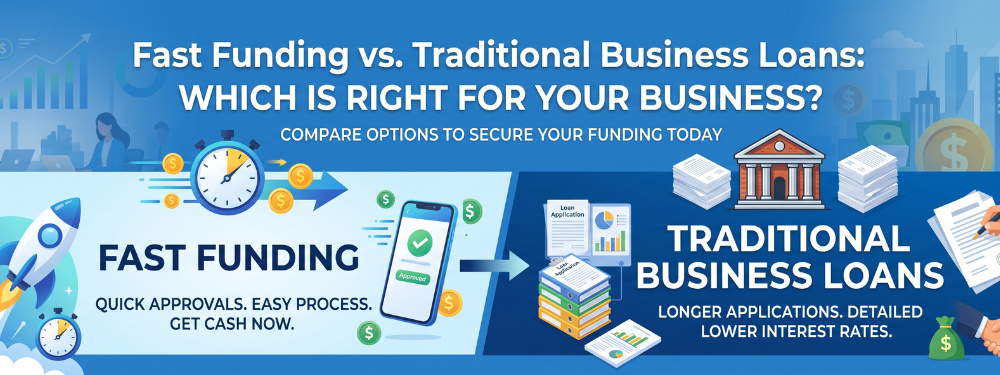
Fast funding can help a business get approved and funded quickly, sometimes as soon as the next business day. Traditional business loans, including bank loans and SBA loans, typically take longer but may offer lower interest rates, longer repayment terms, and more predictable monthly payments.
The best deal depends on your business needs, credit history, credit score, revenue, time in business, and how quickly you need the loan proceeds.
What Is Fast Funding?
Fast funding refers to fast business loans and other business financing designed for speed and flexibility.
Many online lenders and private lenders offer fast business loans with a streamlined application process, minimal paperwork, and quick approval decisions.
In some cases, fast business loans can be approved in minutes. Funds may be available in your account within 24 to 48 hours, or within one to three business days.
Fast funding options may include short-term loans, business lines of credit, merchant cash advances, equipment financing, emergency loans, and certain online term loans.
These loan type options are often used when a company needs money right away.
For example, fast funding may help pay for payroll, inventory, repairs, emergency expenses, seasonal cash flow gaps, or an unexpected expense that cannot wait for a bank’s longer underwriting process.
What Are Traditional Business Loans?
Traditional business loans are usually offered by banks, credit unions, and SBA-approved lenders.
These loans often have a more detailed funding process and underwriting process.
A traditional loan may require business and personal tax returns, bank statements, financial statements, business plans, debt schedules, income records, and other documentation.
Traditional business loans can take weeks or even months to fund.
However, they typically provide lower borrowing costs than many fast business loans.
Traditional business loans often offer interest rates ranging from 7% to 15% APR, depending on the lender, borrower qualifications, loan terms, collateral, and several factors.
SBA loans can fund many business needs and may offer longer repayment terms than fast-funding products.
Traditional loans are often preferable for long-term investments requiring substantial capital, such as expansion, real estate, major equipment, or business acquisition.
Fast Funding vs. Traditional Business Loans
The main difference between fast funding and traditional business loans is speed versus cost.
Fast funding is built for quick access to funds. Traditional loans are built for lower cost and longer-term stability.
Fast business loans can often be approved in hours and funded quickly. Some lenders offer same day funding or next business day funding.
Traditional bank loans and SBA loans usually require more documentation and a longer approval process.
However, fast loans typically have higher interest rates, shorter repayment terms, and more frequent payment schedules.
Traditional business loans may come with a fixed interest rate, fixed monthly payments, and a set period for repayment.
Interest Rates and Borrowing Costs
Interest rate is one of the most important factors when comparing loan options.
Fast funding options often have higher costs of capital, ranging from 15% to over 80% APR.
Fast business loans may carry interest rates from 10% to 350%, depending on the loan type, lender, credit score, repayment terms, and risk.
Merchant cash advances can have APRs from 40% to 350%.
Some lenders charge fees up to 40% of the loan amount.
Fast business loans may also include origination fees that increase total borrowing costs.
Traditional business loans typically offer lower interest rates, often ranging from 7% to 15% APR.
A lower annual percentage rate can reduce total interest paid over the life of the loan.
If you have good credit, strong income, stable revenue, and enough time to wait, a traditional business loan may cost less.
Repayment Terms and Monthly Payments
Repayment terms affect how much you pay each month and how quickly you pay back debt.
Fast loans usually have shorter repayment terms than traditional loans.
Repayment terms for fast loans can be as short as three months.
Shorter repayment terms often lead to higher monthly payments or frequent payments.
Many fast funding options require daily or weekly payment schedules.
This can affect cash flow, especially if your business has uneven sales or seasonal customers.
Traditional business loans typically feature predictable fixed monthly repayments over multi-year terms.
A longer term may make monthly payments more manageable.
For example, a company borrowing money for expansion may prefer a traditional loan with a longer repayment period and fixed payment structure.
However, borrowers should still review the full loan agreement before accepting any funds.






Recent Comments