











For many small businesses, securing affordable financing can determine whether they can hire employees, purchase equipment, expand into new markets, or simply maintain healthy cash flow. While countless financing products exist, SBA loans continue to offer some of the most attractive long-term borrowing options available because they are backed by the Small Business Administration.
One of the most common questions business owners ask is, “What are SBA loan interest rates?” The answer is more nuanced than a single percentage because every loan is priced based on several factors, including the loan amount, repayment term, whether the rate is fixed or variable, the current prime rate, and the individual borrower’s qualifications.
Unlike many private financing products, the Small Business Administration establishes maximum allowable pricing guidelines that participating lenders must follow. These rules help protect small business concerns while allowing banks and other approved lending institutions to appropriately price risk.
At Upwise Capital, we help small businesses compare financing solutions across banks, credit unions, SBA lenders, and specialty finance providers so they can identify the program that best aligns with their long-term growth strategy.
What Is the Small Business Administration?
The Small Business Administration (SBA) is an independent agency of the government that supports small businesses throughout America. Rather than lending money directly in most cases, the agency works with participating bank partners and approved lenders by guaranteeing a portion of qualifying loans.
Because the government assumes part of the risk, participating lenders can often extend financing with lower interest rates, longer repayment terms, and more flexible structures than conventional commercial loans.
Today, the Small Business Administration offers several major financing program options, including, and business owners can also compare additional small business loan options through Upwise Capital:
- SBA 7(a) Loan Program
- SBA 504 Loan Program
- SBA Express
- SBA Microloan Program
- Disaster Loan Program
- 8(a) Business Development Program
Each loan program serves different financing objectives and has unique eligibility requirements.
How SBA Loan Interest Rates Are Determined
Unlike some commercial financing products that use completely discretionary pricing, SBA loan interest rates follow specific guidelines established by the Small Business Administration.
The interest rate a borrower receives is generally determined by several factors, including:
- Current prime rate
- Loan type
- Loan amount
- Repayment term
- Business financial strength
- Personal and business credit
- Available collateral
- Overall risk profile
The Small Business Administration also establishes maximum fixed interest rates and maximum allowable spreads above benchmark rates. This prevents participating lenders from charging excessive pricing while still allowing flexibility for different risk profiles.
Because of these protections, SBA loans remain one of the lowest-cost forms of commercial capital available to qualified small businesses.
Fixed vs. Variable SBA Loan Interest Rates
One of the first decisions many borrowers make involves choosing between fixed and variable pricing.
| Fixed Interest Rate | Variable Interest Rate |
|---|---|
| Payment remains consistent | Payment can change over time |
| Easier budgeting | May begin with lower pricing |
| Better during rising rate environments | Benefits when benchmark rates decline |
| Predictable long-term cost | Subject to changes in the prime rate |
The right choice depends on a company’s financial objectives, expected holding period, and tolerance for changing monthly payment obligations.
Current SBA 7(a) Loan Interest Rates
The 7(a) loan is the Small Business Administration’s flagship financing program and the most flexible option for small businesses.
A 7(a) loan may be used for:
- Working capital
- Purchasing an existing business
- Buying commercial real estate
- Leasehold improvements
- Equipment purchases
- Inventory
- Debt refinancing
- Partner buyouts
- Business acquisitions
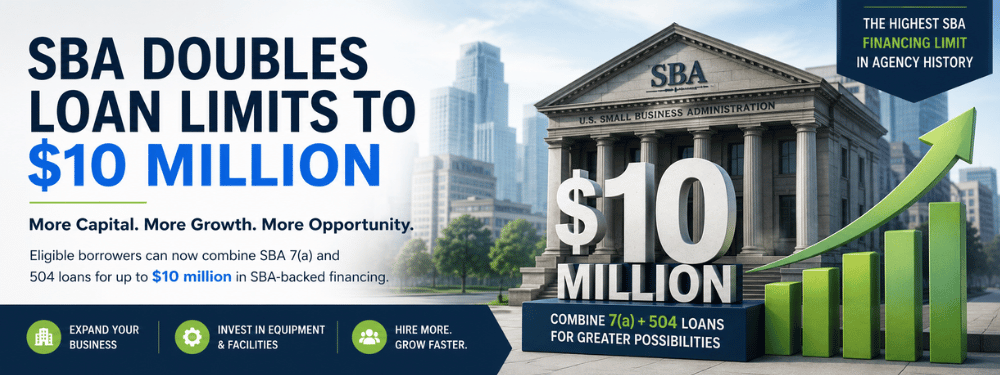
Most 7(a) loans have a maximum loan amount of $5 million.
Current pricing is generally based on the prime rate plus an allowable lender spread established by SBA regulations.
As of today:
- Variable 7(a) loan rates can be as low as approximately 9.75%, depending on the loan amount, repayment term, and borrower profile.
- Maximum fixed interest rates for qualifying 7(a) loans generally range from 11.75% to 14.75%, depending on loan size and maturity.
- Larger loans receive lower allowable spreads because the Small Business Administration reduces the maximum markup as the loan amount increases.
Although these limits establish the ceiling, actual pricing is often negotiated between the borrower and participating lenders.
SBA Guarantees Help Reduce Risk
One reason SBA loans remain attractive is the guaranteed portion provided by the Small Business Administration.
For qualifying loans of $150,000 or less, the SBA generally guarantees up to 85% of the loan.
For larger loans, the guaranteed portion is typically 75%, subject to current SBA guidelines.
Because participating bank partners receive this federal guarantee, they can often approve financing that may not qualify under conventional underwriting while still offering competitive interest pricing.
Why Economic Conditions Affect SBA Rates
Although the Small Business Administration establishes pricing limits, broader market conditions still influence what borrowers ultimately pay.
When the Federal Reserve adjusts monetary policy, the prime rate generally changes. Since many 7(a) loans are tied to that benchmark, monthly payments on variable loans may increase or decrease over time.
Economic conditions also affect lender liquidity, investor demand, and overall borrowing costs across the country. As a result, SBA financing remains market-driven while still benefiting from federal protections that limit pricing.
SBA 504 Loan Interest Rates
While the 7(a) loan is the most flexible loan program, the SBA 504 Program is designed specifically for purchasing long-term fixed assets that help small businesses grow.
Unlike a 7(a) loan, the 504 program cannot generally be used for working capital, inventory, or refinancing short-term debt. Instead, it is commonly used to finance:
- Owner-occupied commercial buildings
- Land purchases
- Major equipment
- Facility construction
- Building expansions
- Leasehold improvements
- Certain long-term fixed assets
Most SBA 504 loans feature fixed interest rates, making them attractive for business owners who want predictable monthly payment obligations over the life of the loan, and learning more about SBA 504 loan structures and benefits can clarify how these projects are financed.
Typical SBA 504 rates generally range between 5% and 7%, although actual pricing depends on Treasury yields, bond market conditions, and the timing of funding.
For companies making significant investments in commercial real estate or equipment, locking in a long-term fixed rate can reduce financing uncertainty while preserving working capital for future growth.
SBA Express Loans
The SBA Express loan program is designed for small businesses that need faster financing decisions.
SBA Express loans currently offer a maximum loan amount of $500,000 and are frequently used for:
- Working capital
- Inventory
- Short-term operating expenses
- Equipment purchases
- Business expansion
Although approval decisions are often faster than traditional SBA financing, interest rates may be slightly higher because participating lenders assume more risk. For many small business owners, the SBA Express program provides an excellent balance between speed and affordability, especially when paired with platforms that offer fast business loan approvals and funding.
SBA Microloans
Not every company requires millions in financing.
The SBA Microloan Program helps newer small businesses, startups, and entrepreneurs obtain smaller amounts of capital.
Microloans provide up to $50,000 and are commonly used for:
- Inventory
- Office furniture
- Equipment
- Supplies
- Marketing
- Initial working capital
Because these loans are administered through nonprofit intermediaries, qualifications and underwriting standards may vary by location.
Disaster Loans Help Businesses Recover
The Small Business Administration also provides Disaster Loans that help businesses recover after declared disasters.
These loans may assist companies affected by:
- Hurricanes
- Floods
- Wildfires
- Tornadoes
- Earthquakes
- Other federally declared disasters
Funding may be used to repair buildings, replace damaged equipment, restore inventory, and resume operations after unexpected events.
For many small businesses, disaster financing plays an important role in helping local communities and the broader economy recover.
SBA Loan Fees Explained
One reason SBA loans remain attractive is that the Small Business Administration regulates many of the fees participating lenders may charge.
Common fees include:
- SBA guarantee fee
- Packaging fees
- Closing fees
- Appraisal fees
- Environmental report fees
- Legal fees
- UCC filing costs
- Recording fees
Many of these fees may be financed into the overall loan amount, reducing the initial cash requirement for the borrower. Since SBA publishes updates regarding guarantee fees and other costs, borrowers should review current guidance before submitting an application. Working with experienced advisors can help identify which fees are required and which may be negotiated or reduced.
Understanding Prepayment Penalties
Many borrowers ask whether SBA loans include prepayment penalties. The answer depends on the loan program.
Certain longer-term 7(a) loans include prepayment penalties when a substantial portion of the outstanding balance is paid during the first few years of the loan. These penalties gradually decline over time.
Most shorter-term SBA loans do not include these restrictions.
If you expect to refinance or pay off your financing early, discussing prepayment penalties before closing is an important part of the decision-making process.
Who Qualifies for SBA Loans?
Although every lender has its own underwriting standards, most applicants should meet several general eligibility requirements.
Typical qualifications include:
- Operate as a for-profit business
- Meet the SBA definition of a small business concern
- Conduct business in America
- Demonstrate the ability to repay the loan
- Have acceptable business and personal credit
- Invest owner equity when required
- Exhaust other reasonable financing options where applicable
Many small businesses with good financial performance, experienced management, and strong cash flow have an excellent chance of obtaining SBA financing.


Recent Comments