


















The Biggest SBA Financing Change in Years
For years, one of the biggest challenges facing small businesses wasn’t finding opportunities—it was finding enough money to capitalize on them.
A manufacturer needed a larger facility but couldn’t finance the building and purchase new machinery without exhausting its working capital. A construction company wanted to expand into neighboring states but lacked sufficient capital to purchase additional equipment and hire experienced employees. A growing family business had customers waiting but couldn’t invest in production because financing limits capped its expansion.
That equation has changed.
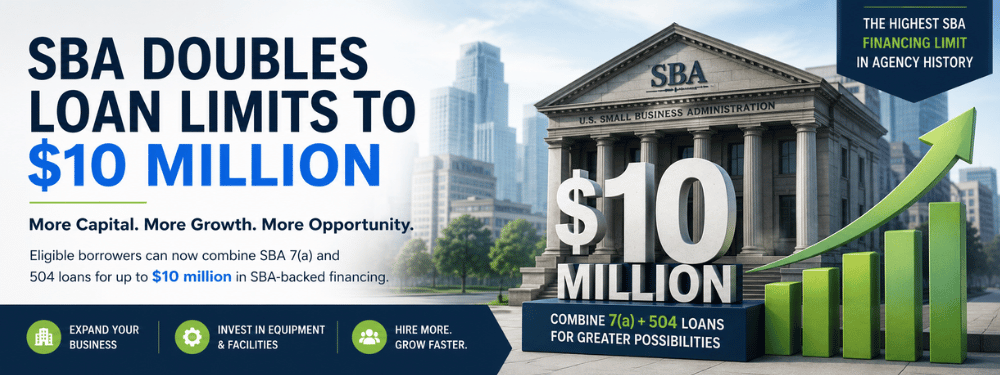
Effective July 4, the Small Business Administration (SBA) implemented one of the most significant lending updates in recent agency history. Under the new rule, many eligible borrowers can now coordinate financing through both the SBA 7(a) and SBA 504 loan program, creating a cumulative loan limit of up to $10 million for qualifying projects.
This means that, instead of relying on a single SBA loan with a $5 million ceiling, qualifying businesses may now access 10 million dollars in coordinated SBA backed financing—the largest SBA’s maximum financing offering ever available for many expansion projects.
For small manufacturers, construction companies, distributors, logistics firms, healthcare providers, and other small businesses in growth mode, this could fundamentally change how they plan, finance, and execute long-term expansion.
What Changed?
For decades, most borrowers viewed SBA financing as having a practical limit of $5 million under the flagship 7(a) loan program.
The new rule changes that.
Today, many eligible borrowers may finance one distinct project by combining:
- Up to $5 million through the SBA 7(a) loan program
- Up to $5 million through the SBA 504 loan program
Together, this creates a cumulative loan limit of 10 million dollars.
This is not simply a larger loan.
It represents an entirely new financing strategy that gives qualifying businesses access to significantly more money without relying exclusively on conventional private lending.
While lender underwriting requirements still apply, the increased flexibility creates opportunities that simply did not exist under previous SBA guidelines.
Why the SBA Increased the Financing Limit
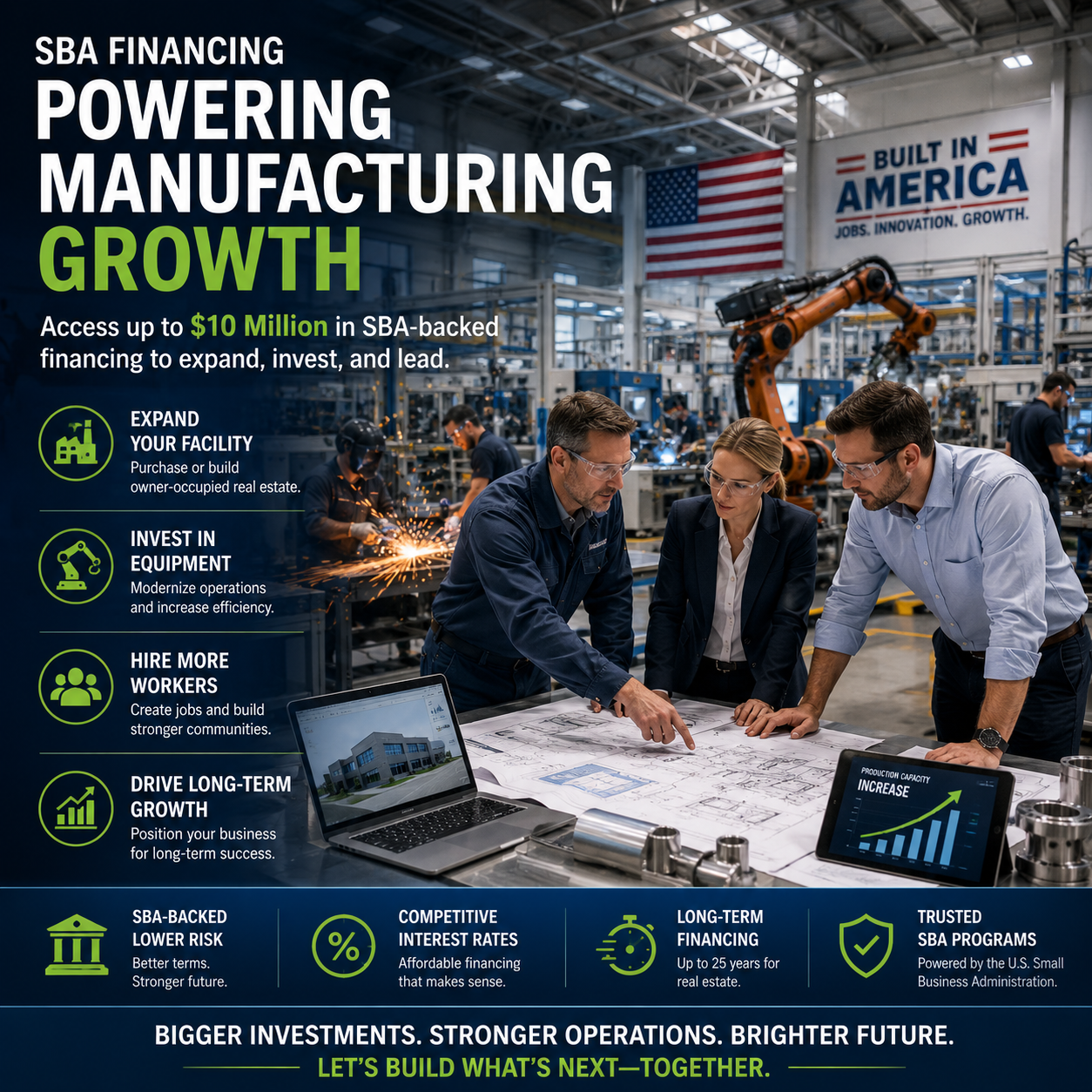
The Small Business Administration has stated that the objective is to help small businesses compete, expand, and invest in America’s economy.
The increased financing capacity is designed to help companies:
- Hire additional employees
- Purchase commercial real estate
- Expand manufacturing capacity
- Increase food production
- Modernize aging facilities
- Build new property
- Purchase advanced equipment
- Support long-term economic growth
- Increase domestic production
According to SBA Administrator Kelly Loeffler, expanding financing capacity helps American businesses meet rising demand driven by continued economic investment and domestic manufacturing initiatives.
For many industries experiencing rising demand, access to additional capital can determine whether a business continues growing—or loses market share to competitors with greater financial resources.
Why This Matters More Than Most Business Owners Realize
Most headlines simply report that the SBA increased loan limits.
The bigger story is what businesses can actually do with that additional capital.
Many companies don’t need more money because they want to spend more.
They need more capital because larger projects naturally require larger financing structures.
Imagine a growing manufacturer that wants to:
- Purchase a $4 million building
- Invest $3 million in automation
- Add $2 million of working capital
- Hire dozens of employees
Previously, these projects often required multiple lenders or expensive private financing.
Now, qualifying borrowers may be able to structure the project using coordinated SBA backed funding, creating a more efficient long-term financing solution.
That’s a significant competitive advantage.
Why Manufacturers Benefit the Most
Although virtually every industry may benefit from the new rule, small manufacturers stand to gain the most.
Manufacturing businesses frequently require substantial investment in:
- Production equipment
- Warehouses
- Distribution centers
- Commercial property
- Automation
- Inventory systems
- Facility expansions
Unlike service companies, manufacturers often need to invest millions before generating additional revenue.
The increased SBA financing limit helps these companies access record levels of affordable capital without relying entirely on conventional lending.
It also supports job creation, domestic manufacturing, and infrastructure expansion throughout America.
For businesses experiencing rising demand, the ability to finance facilities, machinery, and working capital simultaneously may dramatically accelerate growth.
Construction, Distribution, and Logistics Also Stand to Gain
Construction firms, wholesale distributors, transportation companies, and logistics providers often face similar challenges.
Demand may exist.
Customers may be waiting.
But without sufficient cash, businesses cannot purchase additional equipment, lease larger facilities, or hire workers needed to fulfill contracts.
The new rule gives many qualifying companies another option.
Instead of delaying expansion or raising expensive equity from outside investors, they may be able to use coordinated SBA backed financing to fund both fixed assets and operating needs.
This flexibility can preserve ownership while reducing reliance on higher-cost sources of capital.
Why Upwise Capital Believes This Is a Game-Changer
At Upwise Capital, we’ve spent years helping clients secure SBA financing for acquisitions, commercial real estate, equipment purchases, and working capital.
One of the most common obstacles wasn’t credit.
It wasn’t profitability.
It wasn’t even interest rates.
The limitation was simply the available financing amount.
The ability for eligible borrowers to coordinate up to 10 million dollars through SBA programs creates opportunities that previously required complicated financing structures or multiple lending relationships, especially when paired with streamlined business loan options that can fund quickly.
For companies entering a major expansion phase, this change has the potential to reshape long-term financing strategies.
How the New $10 Million SBA Financing Structure Works
The announcement that the SBA doubled loan limits generated significant attention, but many small businesses misunderstood what actually changed.
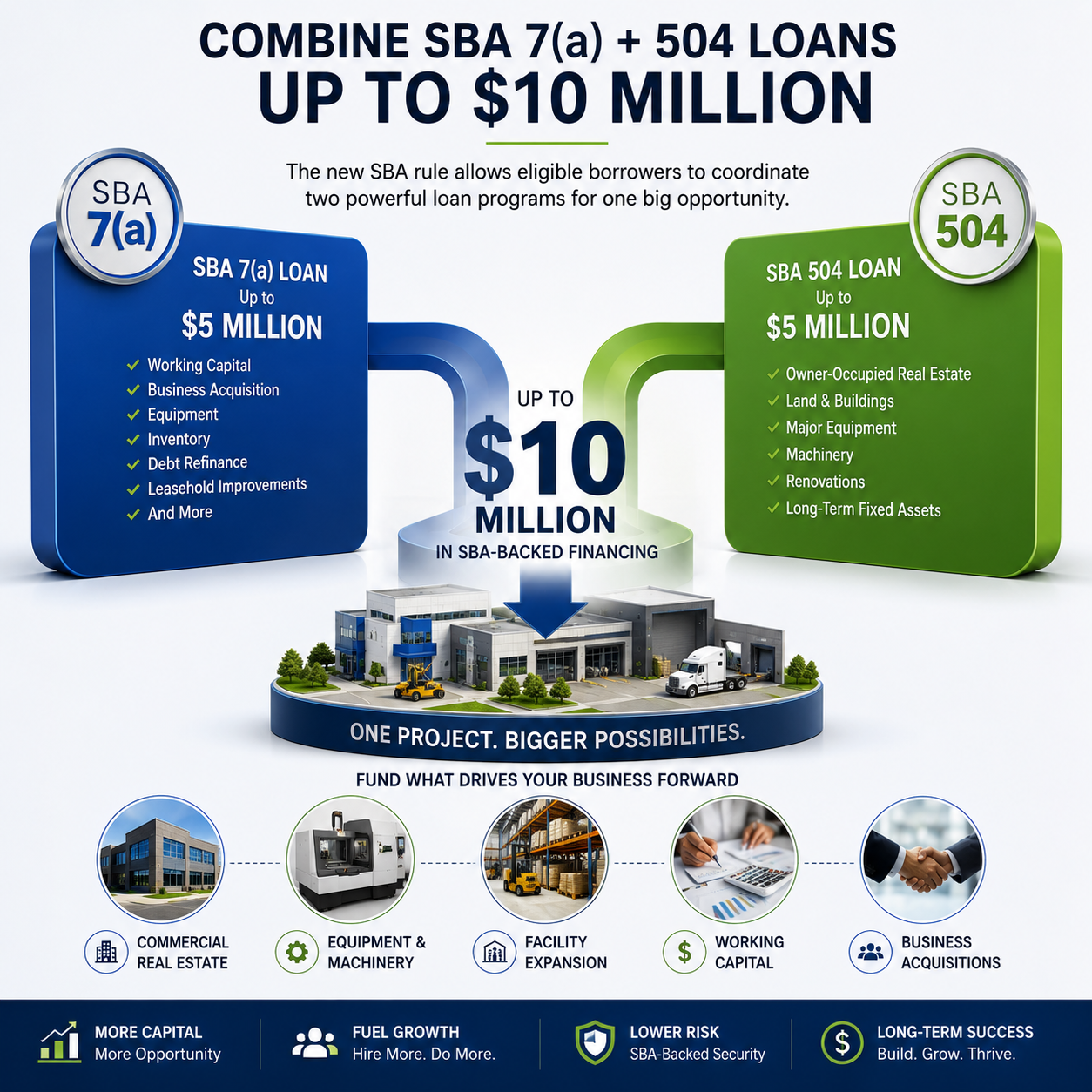
The new rule does not create a single $10 million loan.
Instead, it allows many eligible borrowers to combine financing from two separate SBA programs—the SBA 7(a) and SBA 504 loan program—for the same distinct project. When properly structured, borrowers may access up to 10 million dollars in total SBA-backed financing, giving them substantially more flexibility for expansion.
Think of it as using two complementary financing tools instead of relying on just one. One program can address operational needs through an SBA 7(a) loan for working capital and acquisitions, while the other finances long-term fixed assets.
For businesses making major investments, that distinction is incredibly valuable.
Understanding the Difference Between the SBA 7(a) and SBA 504 Programs
Although both programs are administered by the Small Business Administration, they were created for different purposes.
The 7(a) loan program is designed to provide flexible financing for a wide range of business needs, including:
- Working capital
- Business acquisitions
- Partner buyouts
- Inventory
- Franchise purchases
- Debt refinancing
- Equipment purchases
- Tenant improvements
The SBA 504 loan program, on the other hand, focuses primarily on long-term fixed assets, including many of the real estate and equipment uses covered under the SBA 504 loan program:
- Owner-occupied commercial property
- Manufacturing facilities
- Warehouses
- Distribution centers
- Large machinery
- Heavy equipment
- Industrial buildings
By allowing eligible borrowers to coordinate both programs, the new rule dramatically expands how businesses can structure larger projects.
A Real-World Example of the New Rule
Imagine a manufacturing company planning a major expansion.
The owners want to purchase a larger facility, modernize production, and increase staffing to meet rising demand driven by new customer contracts.
Their project includes:
| Project Need | Estimated Investment |
|---|---|
| Purchase commercial building | $4.5 million |
| Manufacturing equipment | $3 million |
| Facility improvements | $750,000 |
| Initial working capital | $1.25 million |
| Total Investment | $9.5 million |
Under previous financing limits, this project often required a combination of SBA financing, conventional bank debt, mezzanine financing, or higher-cost private capital.
Today, many eligible borrowers may be able to finance substantially more of the project using coordinated SBA programs.
That means more money available for growth while potentially reducing reliance on expensive financing alternatives.
Why This Creates More Flexibility
One of the biggest advantages of the new rule isn’t simply borrowing 10 million dollars.
It’s having greater flexibility in how that capital is allocated.
Instead of exhausting liquidity on real estate purchases, businesses may preserve cash for:
- Hiring employees
- Purchasing inventory
- Marketing
- Technology investments
- Research and development
- Operational improvements
Maintaining liquidity is often just as important as obtaining financing.
Healthy cash reserves help businesses manage unexpected expenses, seasonal fluctuations, supplier pricing, and opportunities that arise after a project is completed.
Capital-Intensive Industries Benefit the Most
Although almost every industry can benefit from greater access to SBA backed funding, certain sectors are especially well positioned.
Industries likely to benefit include:
- Small manufacturers
- Food processing companies
- Construction firms
- Wholesale distributors
- Transportation companies
- Logistics providers
- Medical practices
- Commercial contractors
- Industrial service companies
These businesses routinely invest millions of dollars into facilities, machinery, vehicles, and specialized assets before generating additional revenue.
The increased cumulative loan limit allows qualifying projects to move forward without piecing together several financing sources.
Supporting Growth Without Giving Up Ownership
Business owners often face a difficult choice when expansion opportunities arise.
They can:
- Raise outside equity from investors
- Use expensive private financing
- Delay expansion
- Reduce the size of the project
The Small Business Administration’s expanded financing opportunity creates another option.
Rather than selling ownership or accepting higher financing costs, many companies may be able to use SBA backed financing to fund larger projects while maintaining control of the business.
For many entrepreneurs, preserving ownership can be just as valuable as reducing borrowing costs.
What Businesses Can Use the Additional Capital For
The expanded financing capacity opens the door to projects that previously exceeded SBA lending limits.
Examples include:
- Purchasing a larger commercial property
- Constructing manufacturing facilities
- Expanding production capacity
- Modernizing aging buildings
- Purchasing advanced equipment
- Completing facility renovations
- Acquiring another company
- Adding distribution centers
- Increasing warehouse capacity
- Supporting working capital during expansion
Each project is different, but the common theme is that larger investments often require larger financing solutions.
Approval Still Depends on the Borrower
One important misconception is that every business automatically qualifies for 10 million dollars.
That’s not how the new rule works.
While the Small Business Administration has expanded financing capacity, lenders still evaluate each borrower based on factors such as:
- Business financial performance
- Debt service coverage
- Industry experience
- Management strength
- Available collateral
- Business and personal financial statements
- Existing obligations
- Overall risk
- Ability to repay
Simply because the financing limit has increased does not guarantee approval.
The new rule expands opportunity not automatic eligibility.







Recent Comments