














AI Business Transforming the Future of Enterprise in 2026 Header Funding

AI Business: Transforming the Future of Enterprise in 2026

Navigate

Introduction to AI Business Transformation

The business world is experiencing an unprecedented AI boom. As we move through 2026, artificial intelligence is no longer a futuristic concept—it’s a present-day necessity for maintaining a competitive edge in today’s competitive business landscape.

63% of businesses expect to increase AI investment by 2026, signaling a massive shift in how companies approach digital transformation. This surge in AI technology adoption is reshaping business operations, creating new AI business models, and opening doors for innovative AI business ideas.

Whether you’re looking to start your own business or enhance an existing enterprise, understanding how to leverage AI is crucial for success. This comprehensive guide explores how AI-driven solutions are revolutionizing industries, improving operational efficiency, and creating unprecedented opportunities for growth.


Understanding AI Business Fundamentals
AI Business Drivers

What Defines an AI Business?

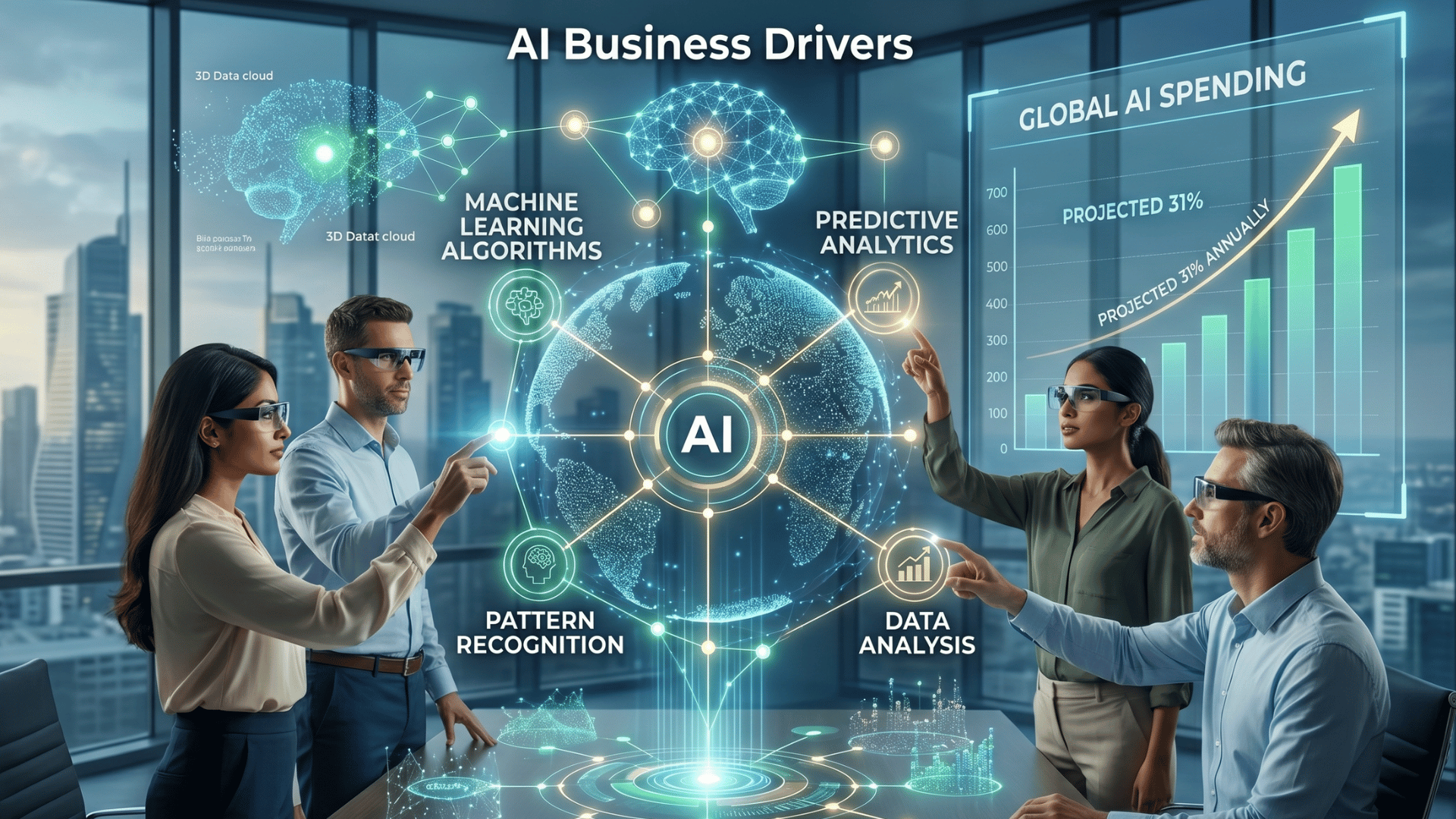
An AI business integrates artificial intelligence AI technologies into its core business processes to enhance decision-making, automate tasks, and deliver superior value to customers. These companies utilize machine learning algorithms, AI models, and AI systems to transform raw data into actionable insights.

AI business models differ from traditional approaches by relying heavily on data analysis, pattern recognition, and predictive analytics to drive strategy. The global AI market continues to expand rapidly, with AI spending projected to grow over 31% annually.

The Current State of AI Adoption

AI use in business operations has doubled since 2017, demonstrating the accelerating pace of adoption. Companies across industries are discovering that AI solutions provide tangible benefits, from reduced costs to improved customer satisfaction.

Business leaders recognize that integrating AI is no longer optional but essential for survival. The competitive advantage gained through AI implementation can mean the difference between market leadership and obsolescence.

AI Tools Revolutionizing Business Operations

Essential AI Powered Tools for Modern Business

AI tools have become indispensable for companies seeking to streamline operations and enhance productivity. From virtual assistants to advanced data analytics platforms, AI-powered tools are transforming how work gets done.

AI software solutions now cover virtually every aspect of business operations:

  • Customer data management systems
  • Process automation platforms
  • AI-based tools for content creation
  • Security AI for threat detection
  • AI platform solutions for enterprise integration

Automating Repetitive Tasks for Efficiency

One of the most significant benefits of AI technology is its ability to automate repetitive tasks. Operational efficiency relies on freeing the workforce from repetitive labor, allowing human talent to focus on strategic, creative, and complex problem-solving activities.

AI tools automate repetitive tasks to improve efficiency in numerous ways:

  • Data entry automation eliminates manual input errors
  • Document processing speeds up administrative workflows
  • Report generation happens automatically on schedule
  • Email sorting and responses are handled intelligently

By handling these repetitive tasks, AI generates significant time savings and allows employees to engage in higher-value work that requires human intelligence.

Enhancing Customer Service with AI

AI Outbound Ai Chatbot

24/7 Customer Support Through AI Chatbots

AI improves customer service with 24/7 availability, ensuring customers receive assistance whenever they need it. AI-powered chatbots provide 24/7 customer service support, eliminating the limitations of traditional business hours and reducing wait times dramatically.

AI chatbots can resolve simple queries without human agents, handling routine questions about:

  • Account information
  • Order status
  • Product details
  • Basic troubleshooting
  • Frequently asked questions

This capability allows sales teams and customer service representatives to focus on complex issues that require emotional intelligence and nuanced understanding.

Personalization Through AI-Driven Insights

AI tools enhance personalization in customer interactions by analyzing customer behavior, user behavior, and customer preferences at scale. AI-powered marketing agencies analyze customer data for personalized strategies, creating tailored experiences that resonate with individual consumers.

Through machine learning, AI systems can:

  • Predict future behavior based on past interactions
  • Recommend products aligned with customer preferences
  • Customize communication styles for different target audience segments
  • Optimize touchpoints throughout the customer journey

The result is enhanced customer satisfaction and stronger loyalty, as customers feel understood and valued.

AI tools can automate customer service, improving response times while maintaining quality, creating a win-win scenario for businesses and consumers alike.

Data Analysis and Insights Generation

Processing Vast Datasets for Meaningful Insights

AI can analyze large datasets to extract meaningful insights at speeds impossible for humans. AI can process vast datasets quickly for insights, transforming overwhelming amounts of information into clear, actionable intelligence.

High-quality data is essential for reliable AI recommendations. The accuracy of AI algorithms depends heavily on the quality of input data and training data fed into machine learning models.

AI tools can automate data analysis tasks to save time, allowing business leaders to make informed decisions based on comprehensive analysis rather than intuition or limited samples.

Advanced Analytics Capabilities

Advanced data analytics powered by artificial intelligence solutions enables companies to:

  • Identify hidden patterns in customer data
  • Detect anomalies that might indicate problems or opportunities
  • Segment markets with unprecedented precision
  • Measure campaign effectiveness in real-time
  • Forecast demand with greater accuracy

AI transforms raw data into a continuous engine for product development and market expansion, creating a sustainable competitive advantage for organizations that master this capability.

Predictive Analytics for Strategic Decision Making

Forecasting Future Outcomes

AI enhances predictive analytics for better decision-making by using historical data to forecast future outcomes. Machine learning algorithms identify trends and correlations that humans might miss, providing a foundation for strategic planning.

Through predictive analytics, businesses can:

  • Anticipate future trends in their industry
  • Predict equipment failures before they occur
  • Forecast sales and revenue more accurately
  • Identify customers at risk of churning
  • Optimize pricing strategies dynamically

This foresight enables proactive rather than reactive management, giving companies a significant competitive advantage.

Optimizing Supply Chain Management

AI can help businesses optimize supply chain management with predictive analytics, addressing one of the most complex challenges in modern business. Supply chain management benefits enormously from AI capabilities in several areas:

Inventory management becomes more precise when AI systems predict demand fluctuations, seasonal variations, and market shifts. This prevents both overstocking and stockouts, optimizing cash flow and customer satisfaction.

AI can help businesses reduce overhead by alleviating operational bottlenecks throughout the supply chain, from procurement to delivery.

Marketing and Content Creation in the AI Era
 AI Era Generative AI Transforming Content Production

Generative AI Transforming Content Production

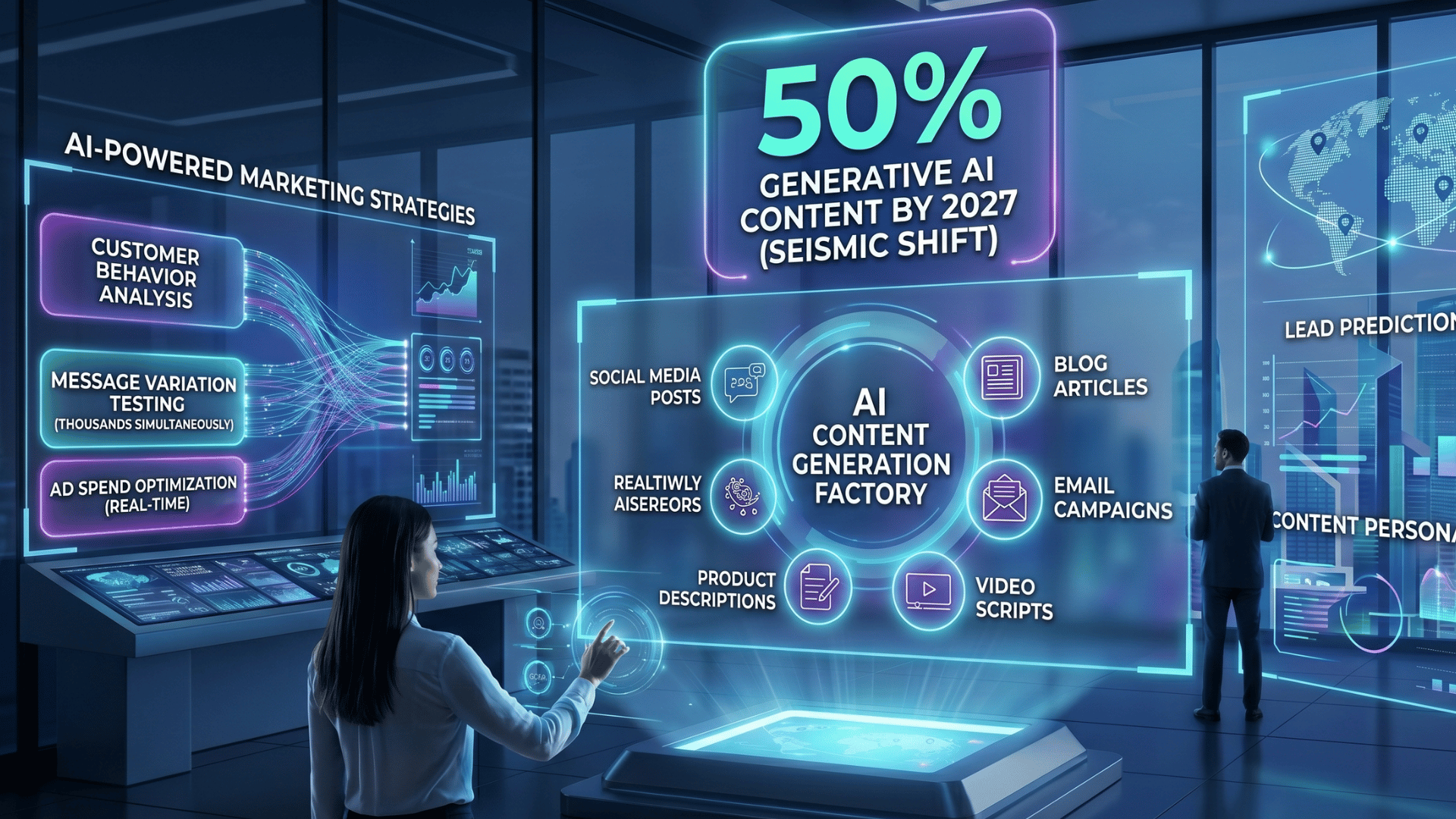
Generative AI will create 50% of marketing content by 2027, fundamentally changing how businesses approach content creation. This statistic represents a seismic shift in marketing plan development and execution.

Generative AI will create 30% of outbound marketing content by 2027, including:

  • Social media posts
  • Blog articles
  • Email campaigns
  • Product descriptions
  • Ad copy variations
  • Video scripts

AI-generated content allows marketing teams to scale production without proportionally increasing headcount, maintaining consistency while reaching more channels and audiences.

AI-Powered Marketing Strategies

AI business success increasingly depends on sophisticated marketing approaches. AI-powered tools enable marketers to:

  • Analyze customer behavior across multiple touchpoints
  • Test thousands of message variations simultaneously
  • Optimize ad spend in real-time
  • Personalize content for individual recipients
  • Predict which leads are most likely to convert

This data-driven approach to marketing ensures resources are allocated efficiently and messages resonate with the intended target audience.

LLC Loan Approved

Apply Now for a Loan Today!

Upwise Capital Logo

AI Business Models and Revenue Strategies

Developing Sustainable AI Business Models

Successful AI business models leverage AI technology to create unique value propositions. Companies must align AI initiatives with core business objectives to ensure technology serves strategy, not the other way around.

Common AI business models include:

  • AI-as-a-Service platforms
  • Data monetization strategies
  • AI-enhanced traditional products
  • Pure-play AI startups
  • Consulting and implementation services

Each model requires different approaches to market research, customer acquisition, and value delivery.

Monetizing AI Capabilities

AI generates revenue through various mechanisms:

  • Subscription-based AI software access
  • Pay-per-use AI solutions
  • Licensing AI algorithms to other companies
  • Selling insights derived from data analysis
  • Offering AI implementation and training services

The key is identifying where AI-driven solutions solve real problems customers will pay to resolve.

Innovative AI Business Ideas

Emerging Opportunities in the AI Space

The AI boom has created numerous AI business ideas for entrepreneurs. Whether you’re launching an AI startup or adding AI capabilities to an existing own business, opportunities abound.

Promising AI business ideas include:

  • Industry-specific AI platform development
  • AI-based tools for niche markets
  • AI-powered tools for professional services
  • Specialized machine learning model training services
  • AI systems integration consulting

AI Business Ideas FAQ

What are the most profitable AI business ideas?

The most profitable AI business ideas typically solve expensive problems in large markets. Customer service automation, predictive analytics for finance, and healthcare diagnostics represent particularly lucrative sectors.

How much capital is needed to start an AI business?

Capital requirements vary widely. Some AI startups can begin with minimal investment using cloud-based AI tools, while others requiring custom AI models and extensive training data may need significant funding.

What skills are needed for AI business success?

Successful AI business ventures require a mix of technical expertise in machine learning, natural language processing, and computer vision, combined with strong business acumen and domain knowledge.

How do I validate my AI business idea?

Conduct thorough market research, interview potential customers, build minimum viable products using existing AI software, and test assumptions before significant investment in custom AI development.

Implementation Strategies for AI Integration

Steps for Successful AI Implementation

Integrating AI into existing business operations requires careful planning and execution. Successful AI implementation follows several key phases:

  1. Assessment: Evaluate current business processes to identify where AI solutions can create the most value
  2. Strategy Development: Create a roadmap aligning AI initiatives with business goals
  3. Data Preparation: Ensure high-quality data is available and properly structured
  4. Technology Selection: Choose appropriate AI tools and AI platforms
  5. Pilot Testing: Start small with controlled experiments
  6. Scaling: Expand successful pilots across the organization
  7. Continuous Improvement: Monitor performance and refine AI systems

Building the Right Foundation

Companies must align AI initiatives with core business objectives to avoid technology for technology’s sake. This alignment ensures AI investment delivers measurable returns.

Essential foundation elements include:

  • Executive sponsorship and business leaders commitment
  • Cross-functional teams with diverse expertise
  • Clear metrics for measuring success
  • Change management processes
  • Ongoing training and development
  • Robust data governance

Addressing AI Challenges and Ethical Considerations

Navigating Ethical AI Deployment

As AI business adoption accelerates, ethical considerations become paramount. Organizations must establish responsible practices to ensure AI technology benefits society while minimizing harm.

Establish ethical guidelines for monitoring algorithms for bias in AI is crucial. AI can reinforce biases in decision-making processes if training data reflects historical prejudices or if AI algorithms aren’t carefully designed and tested.

Transparency in AI systems is crucial for building trust with customers, employees, and regulators. Organizations should be clear about when and how they use artificial intelligence, what data is collected, and how decisions are made.

Privacy and Security Concerns

AI’s reliance on data raises significant privacy concerns. Customer data must be protected through robust security measures and compliance with regulations like GDPR and CCPA.

Poor cybersecurity exposes sensitive client information to risks, making security AI an essential investment. AI systems themselves face unique vulnerabilities:

AI systems face risks from adversarial attacks and misinformation, where bad actors manipulate input data to fool machine learning models into making incorrect predictions or classifications.

Organizations must implement:

  • Encryption for data at rest and in transit
  • Access controls and authentication
  • Regular security audits
  • Incident response plans
  • AI-specific security measures

Workforce Impact and Job Displacement

AI can displace jobs, especially in manual roles, creating legitimate concerns about workforce impact. While AI tools eliminate some positions, they also create new opportunities requiring different skills.

Forward-thinking organizations invest in:

  • Reskilling and upskilling programs
  • Transition support for affected workers
  • Creating new roles that leverage human intelligence alongside AI capabilities
  • Focusing on uniquely human skills like creativity, empathy, and strategic thinking

The goal is augmentation rather than replacement, using AI-driven solutions to enhance human workers rather than eliminate them.

Reducing Human Error Through AI

Enhancing Accuracy in Business Processes

AI can reduce human error in business operations, improving quality and consistency across business processes. AI tools can reduce human error in business processes by:

  • Eliminating manual data entry mistakes
  • Applying rules consistently without fatigue
  • Catching errors humans might miss
  • Validating information in real-time
  • Standardizing procedures across locations

This reduction in human error translates to cost savings, improved compliance, and better customer experiences.

Quality Control and Compliance

AI systems excel at maintaining quality standards and ensuring regulatory compliance. They can:

  • Monitor transactions for suspicious activity
  • Verify documents meet requirements
  • Track compliance with industry regulations
  • Generate audit trails automatically
  • Flag potential issues for human review

This automated oversight reduces risk while freeing employees to focus on exception handling and strategic activities.

Measuring AI Business Success

Key Performance Indicators for AI Initiatives

Measuring the success of AI business initiatives requires clear metrics aligned with business objectives. Common KPIs include:

Operational Efficiency Metrics:

  • Time saved through process automation
  • Cost reduction from automating routine tasks
  • Error rate decreases
  • Throughput improvements

Customer-Focused Metrics:

  • Customer satisfaction scores
  • Response time improvements
  • Resolution rates for AI chatbots
  • Personalization effectiveness
  • Customer engagement levels

Financial Metrics:

  • Return on AI investment
  • Revenue growth from AI-generated content or recommendations
  • Cost per transaction
  • Customer lifetime value improvements

Continuous Optimization

Successful AI business operations require ongoing monitoring and refinement. Machine learning models need regular retraining with fresh data. AI algorithms should be tested against new scenarios. Performance should be benchmarked against competitors and industry standards.

Future Trends in AI Business

Emerging Technologies Shaping the Future

The future trends in AI business point toward even more sophisticated applications:

Advanced AI Capabilities:

  • More powerful natural language processing enabling human-like conversations
  • Improved computer vision for visual analysis and recognition
  • Enhanced pattern recognition across complex datasets
  • Better predictive analytics with longer time horizons

Integration and Accessibility:

  • No-code AI platforms democratizing access
  • Pre-built AI solutions for common business problems
  • Cloud-based AI tools reducing infrastructure requirements
  • API-first approaches enabling easy integration

Industry-Specific Applications:

  • Healthcare diagnostics and treatment planning
  • Financial services fraud detection and risk assessment
  • Manufacturing predictive maintenance
  • Retail personalized shopping experiences
  • Agriculture precision farming

Preparing for the AI-Driven Future

Business world transformation through artificial intelligence solutions will continue accelerating. Companies that invest now in AI technology, build AI capabilities, and develop AI business models will be best positioned for success.

The global AI market expansion creates opportunities for both established enterprises and AI startups. Success requires:

  • Commitment to continuous learning
  • Willingness to experiment and fail fast
  • Investment in data infrastructure
  • Focus on solving real customer problems
  • Ethical and responsible AI deployment

Conclusion: Embracing the AI Business Revolution

The AI business revolution is here, transforming how companies operate, compete, and deliver value. With 63% of businesses expecting to increase AI investment in three years, the momentum is undeniable.

From customer service improvements through 24/7 availability to operational efficiency gains by freeing the workforce from repetitive labor, AI-driven solutions offer tangible benefits across every business function.

Generative AI creating 30% of marketing content, predictive analytics optimizing supply chain management, and AI tools automating data analysis represent just the beginning of what’s possible.

Success in this new landscape requires:

  • Strategic AI implementation aligned with business goals
  • Investment in high-quality data and AI platforms
  • Commitment to ethical AI practices
  • Continuous learning and adaptation
  • Balance between AI capabilities and human intelligence

Whether you’re exploring AI business ideas, launching an AI startup, or transforming an existing enterprise, the time to act is now. The competitive business landscape rewards those who embrace artificial intelligence thoughtfully and strategically.

Start your AI business journey today, and position your organization to thrive in an increasingly AI-driven world.

SHARE

Leave a Reply

Your email address will not be published. Required fields are marked *

Other Articles You May Want to Read