
Schedule III Rescheduling & The End of 280E: What It Means for Cannabis Financing in 2026

Navigate
The Rescheduling Revolution
On December 18, 2025, President Trump issued an executive order instructing the attorney general to expedite and complete the process of rescheduling marijuana from Schedule I to Schedule III.[1] This isn’t just another political headline—it’s potentially the most significant financial event in the history of the legal cannabis industry.
Two months after Trump’s executive order, cannabis remains Schedule I. The DEA has no judge, the AG has gone silent, and 48 GOP lawmakers want rescheduling dead.[9] However, stakeholders should plan for multiple scenarios, including a final rule that becomes effective without interruption in 2026 and alternatives in which litigation delays implementation.[3]
Why does this matter for your business? One word: 280E.
Understanding the 280E Tax Nightmare

Section 280E of the Internal Revenue Code represents one of the most significant financial challenges facing cannabis businesses today. Enacted in 1982 as part of the Tax Equity and Fiscal Responsibility Act, this provision prohibits businesses trafficking in controlled substances from deducting ordinary business expenses when calculating federal taxable income.[1]
While originally intended to prevent drug dealers from claiming tax deductions, 280E now applies to state-legal cannabis businesses, creating a unique and often devastating tax burden that can push effective tax rates above 70%.[1]
For cannabis businesses, Section 280E means that they cannot deduct ordinary and necessary business expenses, such as rent, utilities, and employee salaries, from their taxable income. This results in a significantly higher effective tax rate compared to other businesses.[5]
Indirect expenses such as website design, charitable contributions, meals and entertainment, franchise fees, banking service charges, advertising, and marketing are never deductible for legal cannabis retailers under Section 280E.[2]
The Schedule III Solution
The rescheduling of marijuana to Schedule III would render IRC Section 280E inapplicable to cannabis businesses. The DOJ’s 2024 proposed rule explicitly acknowledges this economic impact.[3]
Because the provision applies only to activities involving substances in Schedule I or II, moving marijuana from Schedule I to Schedule III would allow marijuana businesses to deduct business expenses on federal tax filings.[4]
This single change would dramatically improve cash flow, profitability, and—critically—your ability to qualify for and service cannabis business financing.
Real-Life Scenario: Green Valley Dispensary

Let’s look at how Schedule III rescheduling could impact a typical cannabis dispensary. Meet Green Valley Dispensary, a fictional but realistic single-location dispensary in Colorado.
| Financial Metric | Amount |
|---|---|
| Annual Gross Revenue | $2,000,000 |
| Cost of Goods Sold (COGS) | $1,200,000 |
Operating Expenses (rent, payroll, marketing, utilities, etc.) | $500,000 |
| Gross Profit | $800,000 |
| Net Profit (before taxes) | $300,000 |
Scenario A: Under Current 280E (Schedule I)
Under current law, Green Valley can only deduct COGS not their $500,000 in operating expenses.
| Tax Calculation | Amount |
|---|---|
| Gross Revenue | $2,000,000 |
| Less: COGS (deductible) | -$1,200,000 |
| Taxable Income | $800,000 |
| Federal Tax (21% corporate rate) | $168,000 |
Applying similar logic to Green Valley at a 30% effective rate:
| Actual Tax Burden (280E) | Amount |
|---|---|
| Taxable Income | $800,000 |
| Tax at ~30% effective rate | $240,000 |
| Cash Remaining After Tax | $60,000 |
Green Valley made $300,000 in actual profit but owes $240,000 in taxes leaving only $60,000 in cash. That's an effective tax rate of 80% on their true profits.
Scenario B: After Schedule III Rescheduling (No 280E)
Had the business been allowed to deduct the other $200,000 in business expenses, its tax burden would have been reduced to $15,000 ($50,000 taxable income x 0.30).[6]
| Tax Calculation (Post-280E) | Amount |
|---|---|
| Gross Revenue | $2,000,000 |
| Less: COGS | -$1,200,000 |
| Less: Operating Expenses (NOW DEDUCTIBLE) | -$500,000 |
| Taxable Income | $300,000 |
| Federal Tax (~30% effective rate) | $90,000 |
| Cash Remaining After Tax | $210,000 |
The Difference: $150,000 in Annual Savings
That extra $150,000 per year changes everything when it comes to cannabis business financing:
1. Improved Loan Qualification
Lenders evaluate debt service coverage ratio (DSCR)—your ability to cover loan payments with operating cash flow. With $210,000 in cash versus $60,000, Green Valley could comfortably service a loan of $1 million or more that would have been impossible before.
2. Better Loan Terms
Stronger cash flow means lower risk for lenders. Green Valley could negotiate lower interest rates, longer repayment terms, and more favorable covenants.
3. Expanded Use of Funds
With 280E eliminated, financing can be used for previously “non-deductible” growth investments:
- Marketing and advertising campaigns
- Employee training and benefits
- Technology and software upgrades
- New location buildouts
4. Working Capital Flexibility
Cannabis businesses often need working capital loans to manage cash flow. When you’re not sending 80% of your profits to the IRS, maintaining adequate working capital becomes dramatically easier.
How Green Valley Could Use Financing Post-280E
With improved cash flow, Green Valley approaches Upwise Capital for a $500,000 term loan to open a second location.
Under 280E: $60,000 cash flow ÷ $133,464 debt service = 0.45 DSCR ❌ (Loan denied—insufficient cash flow)
Without 280E: $210,000 cash flow ÷ $133,464 debt service = 1.57 DSCR ✅ (Loan approved—healthy coverage)
Preparing for the Transition
Treat 2026 as a “change-in-law” year: model post-280E economics, stress-test contracts and disclosures for shifting tax and regulatory assumptions, and maintain diligence-ready compliance documentation as the rulemaking and litigation landscape evolves.[10]
Companies should also monitor for interim Internal Revenue Service guidance on Section 280E transition and for financial regulators’ expectations as rescheduling approaches.[3]
Action Steps for Cannabis Operators

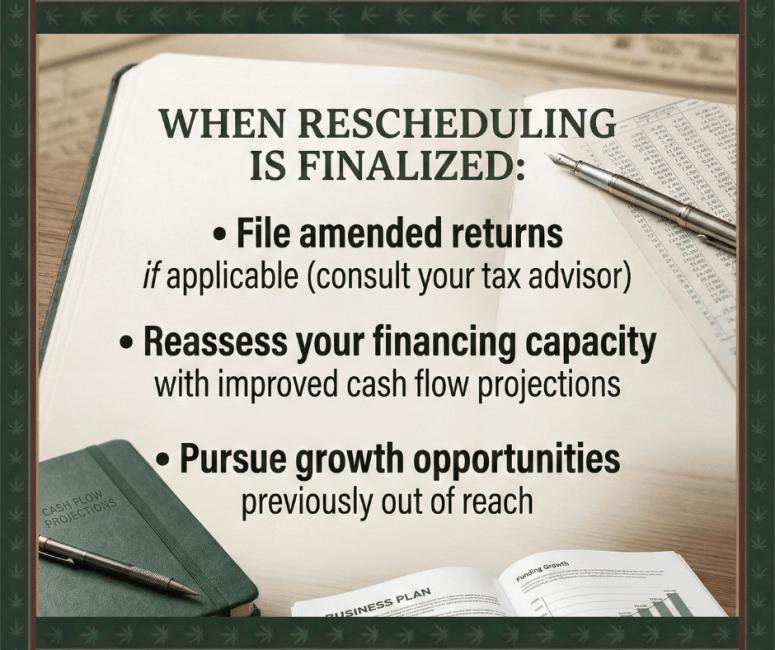
To prepare for a potential future without the heavy tax burdens of 280E, cannabis operators should take specific actions both now and when rescheduling is finalized. Immediately, operators should work with their CPA to model post-280E financials and ensure meticulous record-keeping for all operating expenses. Additionally, building relationships with cannabis-friendly lenders like Upwise Capital is recommended. Once rescheduling is finalized, operators should consult a tax advisor regarding filing amended returns, reassess financing capacity based on improved cash flow projections, and pursue previously out-of-reach growth opportunities.
The Bottom Line
Schedule III rescheduling isn’t just a political talking point it’s a potential financial transformation for cannabis businesses. For decades, state-legal cannabis operators have faced effective tax rates that can exceed 70% due to IRC Section 280E.[3] The elimination of this burden could unlock billions in capital across the industry.
Whether rescheduling happens in 2026 or faces further delays, smart operators are planning for both scenarios. The businesses that prepare now building strong financials, maintaining compliance documentation, and establishing lending relationships will be positioned to capitalize when the change comes.
Ready to explore your cannabis financing options? Upwise Capital specializes in funding solutions for cannabis businesses, offering working capital, equipment financing, and term loans up to $10 million. Contact us today to discuss how we can help you grow today and in the post 280E future.
This article is for informational purposes only and does not constitute tax or legal advice. Consult qualified professionals for guidance specific to your situation.
Application Process for Cannabis MCA Funding
Apply for a Cannabis Financing Today.
- Pursue new opportunities, upgrade operations, support inventory or boost marketing efforts.
- Apply today to unlock working capital that supports your goals without restrictions.
- Close the cash flow gap within your cannabis company or bridge the financing divide between your short-term and long-term goals.
Stay ahead of the curve - get access today!
So…What do you think?
We want to hear from you. What do you think of this article, and was it helpful in your search for understanding rescheduling?
Let us know by leaving a reply below. Feel free to share this article on your social media.
SHARE
Other Articles You May Want to Read





Recent Comments